Revenue Optimization for Apps That Actually Grows Profit
Master revenue optimization for mobile apps — metrics, pricing tests, monetization models and a checklist for React Native teams to grow ARPU and LTV.
 Damini
You shipped your React Native app, installs started coming in, and the graph finally moved up and to the right. Then revenue flattened.
That's the point where a lot of indie founders make the same mistake. They assume they need more traffic, more ad spend, or another launch push. Sometimes they do. But often the bigger problem sits inside the app: the paywall converts unevenly, the wrong users see the wrong offer, renewals fail, and nobody is reading cohorts closely enough to catch the leak.
Revenue optimization is the discipline that fixes that. Not with hacks, and not by randomly raising prices, but by treating monetization like a system. You already have users, product value, and a limited set of moments where people decide whether to pay. Those moments are your scarce capacity.
Revenue optimization means getting more profit from the demand you already have by improving pricing, packaging, timing, retention, and the data flows that help you make those decisions.
For mobile teams, that system usually touches four things first: pricing, paywalls, billing recovery, and cohort analytics. If you're building with Expo and React Native, the good news is you don't need enterprise infrastructure to start doing this well. You need clean event tracking, stable experiment assignment, a subscription stack that can measure beyond install-to-trial, and a habit of reading user groups over time instead of staring at one blended dashboard.
Table of Contents
- Introduction Why Downloads Alone Do Not Pay the Bills
- What Revenue Optimization Really Means and Where It Came From
- Core Metrics That Drive Revenue Optimization Decisions
- Choosing the Right Monetization Model for Your Mobile App
- Pricing and Paywall Experiments That Move Revenue Most
- Analytics and Cohort Analysis That Reveal Hidden Revenue Leaks
- Your Revenue Optimization Checklist for React Native Teams Using AppLighter
Introduction Why Downloads Alone Do Not Pay the Bills
A common indie app story goes like this. You launch a habit app, AI utility, fitness tracker, or niche productivity tool. Your App Store screenshots are solid, creator posts drive some installs, and your onboarding completion rate looks decent. But subscription revenue stays uneven month after month.
The reason is simple. Downloads are not revenue. They're just the top of the funnel. A user only becomes meaningful to the business when they activate, see value, hit the paywall, start paying, keep paying, and avoid preventable churn.
That's where many founders get stuck. They look at gross install numbers and expect monetization to take care of itself. It rarely does. Mobile revenue is usually won or lost in small operational details: what price you show, when you show it, how clearly the plans are framed, whether failed renewals get recovered, and whether your analytics can separate a strong cohort from a weak one.
The gap between usage and money
Think of your app like a small restaurant with limited seats. Getting people to walk past the window matters. But profit depends on who comes in, what they order, whether service is smooth, and whether they come back.
Apps work the same way. Your scarce resource isn't physical seating. It's the number of high-intent moments each user gives you.
Those moments include:
- First value reached: The user finally understands why the app matters.
- Paywall exposure: They decide whether your offer feels worth it.
- Renewal date: Their card succeeds, fails, or they cancel.
- Upgrade decision: They move to a higher-value plan or stay put.
If you waste those moments, more acquisition won't save the model.
The fastest path to better app revenue usually isn't “get more users.” It's “stop under-monetizing the users who already said yes to your product.”
For React Native founders, this matters even more because small teams can't afford to optimize ten things at once. You need a priority order. Start with the levers that move actual cash, not vanity metrics. Then build a repeatable loop around measurement, testing, and retention.
What Revenue Optimization Really Means and Where It Came From
Revenue optimization began as a capacity problem.
Airlines made it famous because an empty seat loses all value once the plane leaves the gate. After deregulation in the United States, carriers had more freedom to change fares and had to get better at deciding which customer should get which seat, at which price, at which moment. That pressure pushed the rise of revenue management and dynamic pricing systems, as described in this history of dynamic pricing and revenue management.
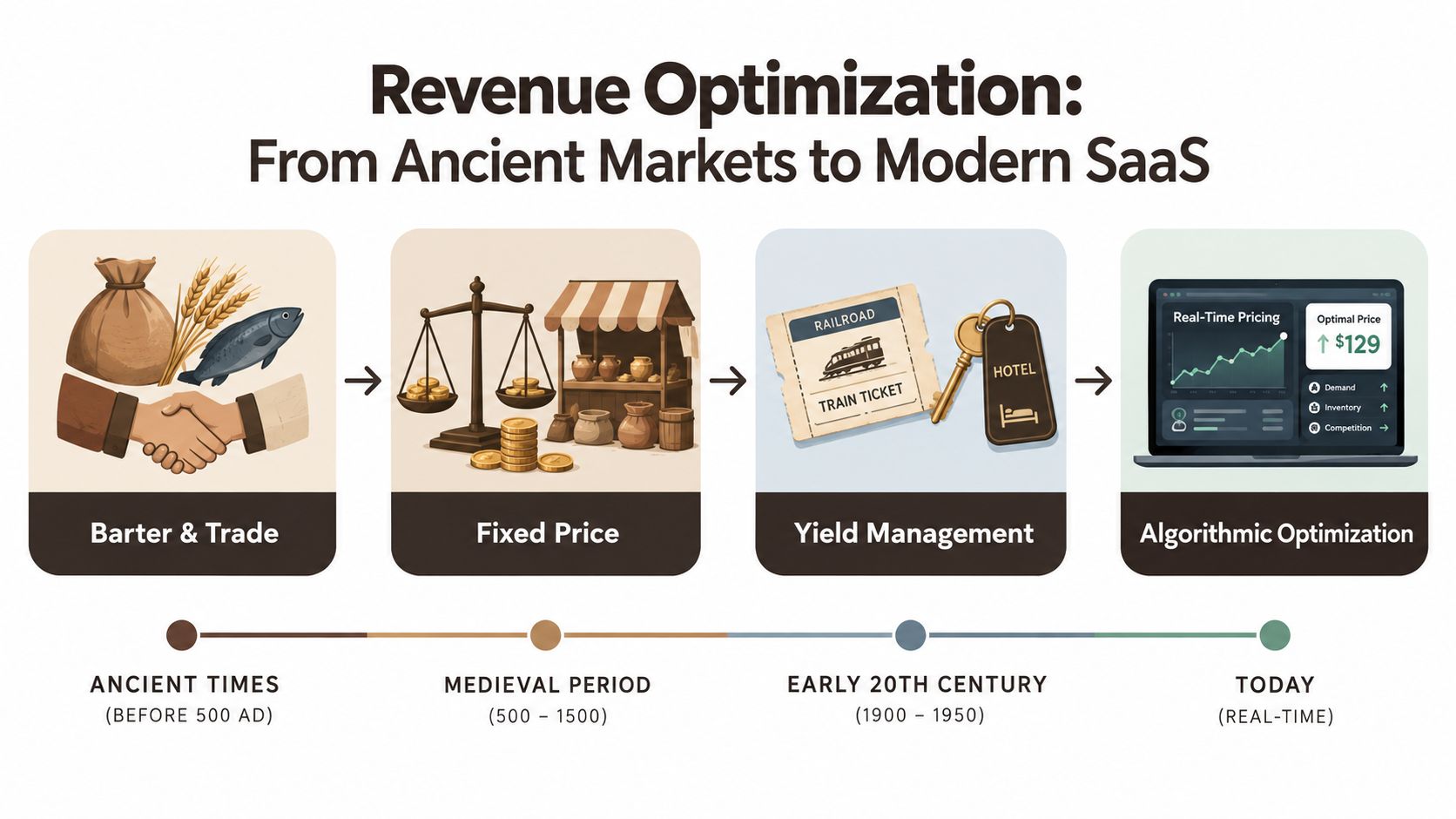 A timeline chart titled Revenue Optimization showing the evolution from ancient barter systems to modern algorithmic pricing.
The original logic still applies
A subscription app does not have seats, but it does have scarce capacity. The scarce part is not server space. It is the small number of moments where a user is willing to evaluate value and make a payment decision.
That is why revenue optimization is broader than pricing.
For an indie React Native team, the job is to manage a limited set of monetization opportunities well:
- A first paywall view
- A trial start and trial end
- A chance to present annual versus monthly
- A billing retry after a failed renewal
- A moment when a retained cohort may accept an upgrade
Each one works like inventory. If you waste it with poor timing, weak packaging, or missing recovery flows, you usually do not get that exact moment back.
This framing matters because founders often hear "revenue optimization" and reduce it to "raise the price." Price matters, but revenue optimization is really the system behind value capture. It asks whether the right user saw the right offer at the right time, whether failed renewals were recovered, and whether you can tell a strong cohort from a weak one. If you want a broader practical framing of how teams optimize subscription revenue, the subscription lens is useful because it forces attention onto retention and recovery, not just conversion.
A mobile app version of revenue management
Say your app offers a premium writing assistant. One user wants occasional help and will stay free unless the jump to paid feels small and clear. Another uses the app every day and may respond better to an annual plan with stronger value framing. A third gets real value but churns by accident because their card fails and nobody follows up.
Those are three different revenue problems. None are solved by one blanket price change.
Revenue optimization gives you a decision system:
- Identify the highest-value bottleneck first.
- Test the offer or price where user intent is already high.
- Recover involuntary churn before chasing new top-of-funnel growth.
- Read results by cohort so one noisy week does not mislead you.
For small React Native teams, tooling changes the pace of learning. A wired-up stack such as AppLighter helps connect paywall events, subscription status, failed renewals, and cohort behavior in one place, so pricing tests are easier to prioritize and revenue leaks are easier to spot.
Good revenue optimization reduces mismatch. It does not pressure every user harder. It matches offers to actual willingness to pay and protects revenue that should have been collected in the first place.
That is how the idea moved from airline yield management into hotels, software, and subscription apps. The industry changed. The logic did not. Revenue goes up when you treat monetization as a capacity allocation problem and focus first on the few decisions that control most of the cash outcome.
Core Metrics That Drive Revenue Optimization Decisions
A small React Native team usually does not have a traffic problem first. It has a capacity problem. You have limited room to ship tests, limited time to inspect bugs, and limited attention for the parts of the funnel that move cash. The job of revenue optimization is to point that attention at the few metrics that tell you where scarce team capacity should go.
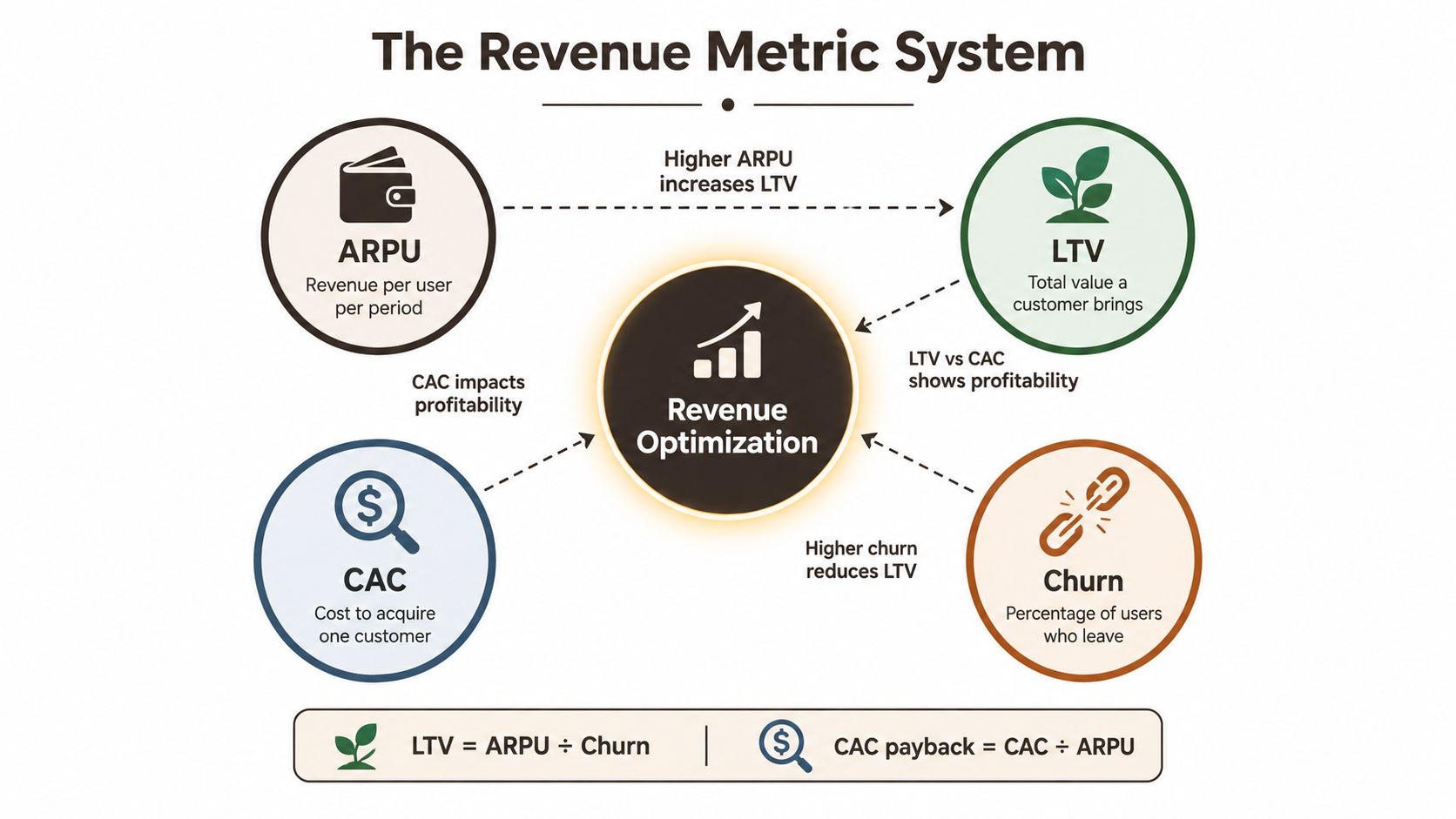 A diagram illustrating the revenue optimization system showing relationships between ARPU, CAC, LTV, and customer churn metrics.
Read ARPU and churn together
ARPU is average revenue per user over a set period. It answers a simple question: how much revenue does one user produce, on average, this week, this month, or this year?
Churn measures how quickly paying users leave, cancel, or fail to renew. ARPU shows what comes in. Churn shows how fast it slips out.
A bucket works as a useful analogy here. Price, packaging, and paywalls help you pour more water in. Churn tells you how big the holes are. If you only watch revenue coming in, you can mistake a leaking bucket for a healthy one.
That leads to four common readings:
- Higher ARPU and lower churn: the offer is producing more revenue and holding it longer.
- Higher ARPU and high churn: the app may be pushing users into a plan they do not keep.
- Lower ARPU and strong retention: the product may support a stronger plan structure or better upgrade path.
- Flat ARPU and rising churn: check failed renewals, onboarding friction, or a weak fit between promise and delivered value.
For indie subscription apps, this is often the first useful fork in the road. Do you have a pricing problem, or a retention problem that pricing cannot fix?
Use LTV and CAC to decide whether growth is safe
LTV, or lifetime value, estimates how much revenue a customer produces before they leave. CAC, customer acquisition cost, tells you what you spent to get that customer.
These metrics only help when read in sequence. Founders often jump to CAC because ad spend feels urgent. That is like buying more fuel before checking whether the engine is leaking oil.
Use this order instead:
- Check ARPU. Is each user producing enough revenue to matter?
- Check churn. Do they stay long enough for that revenue to accumulate?
- Estimate LTV. Does the cohort keep paying long enough to support the model?
- Compare CAC. Are you buying growth at a price the app can earn back?
One short rule helps here. If conversion looks decent but cash still feels thin, inspect renewals and failed payments before you spend more to acquire users.
For small teams, metrics are a triage system
These metrics are not just finance terms. They are a work queue.
If churn is the weak point, the next best use of engineering time may be dunning flows, billing retries, and subscription state tracking. If retention is healthy but ARPU is soft, pricing tests and paywall packaging move up the list. If CAC is under pressure, pause broad acquisition experiments until the app keeps more of the revenue it already generates.
That is the practical value of a wired-up stack like AppLighter. It connects paywall events, subscription status, failed renewals, and cohort behavior so a small team can see whether the next test should be a price change, a paywall message change, or an involuntary churn recovery fix.
Ownership matters more than dashboard count
Many indie teams have event data but still struggle to make revenue decisions. The issue is rarely a lack of charts. The issue is that nobody owns the revenue system end to end.
Larger companies often solve this with revenue operations. One revenue operations industry statistics summary points to stronger growth and lower revenue leakage when teams coordinate data, process, and ownership around revenue. An indie founder does not need a formal RevOps department, but the operating habit still applies. One person needs to review pricing tests, instrumentation quality, renewal failures, and cohort results on a regular cadence.
Otherwise, metrics become decoration.
A simple diagnosis framework
If the numbers feel noisy, start here:
- Weak ARPU, decent retention: test packaging, price anchors, trial structure, or plan naming.
- Strong conversion, weak LTV: inspect early churn and failed renewals before changing acquisition.
- High CAC pressure: reduce paid growth pace and improve monetization efficiency first.
- Messy dashboards or conflicting numbers: fix instrumentation before running more experiments.
- Good top-line revenue, unstable cohorts: break results out by install month, acquisition source, and plan type.
The goal is not to watch more metrics. The goal is to use a small set of connected metrics to decide where limited app capacity should go next. That is what turns revenue optimization from a vague growth idea into an operating system for pricing tests, churn recovery, and cohort analysis.
Choosing the Right Monetization Model for Your Mobile App
The right monetization model depends less on trend-following and more on user behavior. A journaling app, a kids learning app, and a niche B2B field tool shouldn't all charge the same way.
The mistake is copying the category leader without asking what your users buy. Some apps are used daily. Some solve a single expensive problem. Some attract broad free usage and need ads or entry-level access to keep the funnel healthy.
Match the model to the product
Subscriptions work best when the app keeps delivering value over time. Think meditation, fitness, language learning, creator workflows, or anything users revisit regularly.
In-app purchases fit when users buy discrete value. Extra credits, content packs, templates, or one-off purchases make sense when usage is bursty or feature access is modular.
Ads can work when usage is broad and willingness to pay is low, but they create a direct UX trade-off. Every ad impression competes with focus, speed, and trust.
Freemium sits in the middle. It gives users enough value to form a habit, then reserves the strongest convenience, depth, or scale for paid tiers.
Here's a simple comparison:
| Model | Revenue Pattern | UX Trade-off | Best Fit |
|---|---|---|---|
| Subscription | Recurring and compounding if retention holds | Requires ongoing value and careful churn management | Habit apps, utilities, coaching, productivity |
| In-app purchases | Transactional and event-driven | Can fragment the product if overused | Games, creator tools, content unlocks |
| Ads | Broad monetization across non-payers | Risks clutter and slower experience | High-usage, low-intent consumer apps |
| Freemium | Mixed funnel with paid upsell path | Needs clear premium boundary | Apps where users need proof before paying |
When hybrid models help
Hybrid models can work, but only when each layer has a job.
Examples:
- A free app with ads plus an ad-free subscription.
- A subscription app with premium content sold as add-ons.
- A freemium utility with one-time purchases for specialist packs.
Hybrid models fail when they confuse the user. If your paywall sells unlimited access, but half the value is still trapped in separate purchases, buyers hesitate. They can't tell what “premium” means.
A practical way to choose is to ask three questions:
- How often does the user get value? Frequent value supports subscriptions.
- Is the value ongoing or finite? Finite value often fits one-time purchases better.
- Will monetization interrupt the core job? If yes, be careful with ads.
If you're mapping those choices against implementation details, AppLighter's guide on how to monetize apps is useful because it frames subscriptions, freemium, ads, and purchases as operational choices, not just pricing labels.
What indie React Native teams should avoid
Don't stack multiple weak models on top of a blurry product. That usually means the team doesn't trust any single value proposition enough to lead with it.
A cleaner path is to pick one primary model, support it with one secondary lever if needed, and instrument the full flow. If users can't tell what they're paying for in one screen, the model isn't ready yet.
Pricing and Paywall Experiments That Move Revenue Most
Many teams spend weeks changing button colors and headline copy while avoiding the harder question: are we charging the right price?
That's backwards. One subscription experimentation playbook reports that pricing tests can lift revenue by up to 80%, while visual paywall changes top out around 30% and country-based pricing around 15%, based on this paywall experiments playbook. For small teams, that's a gift. It tells you where to start.
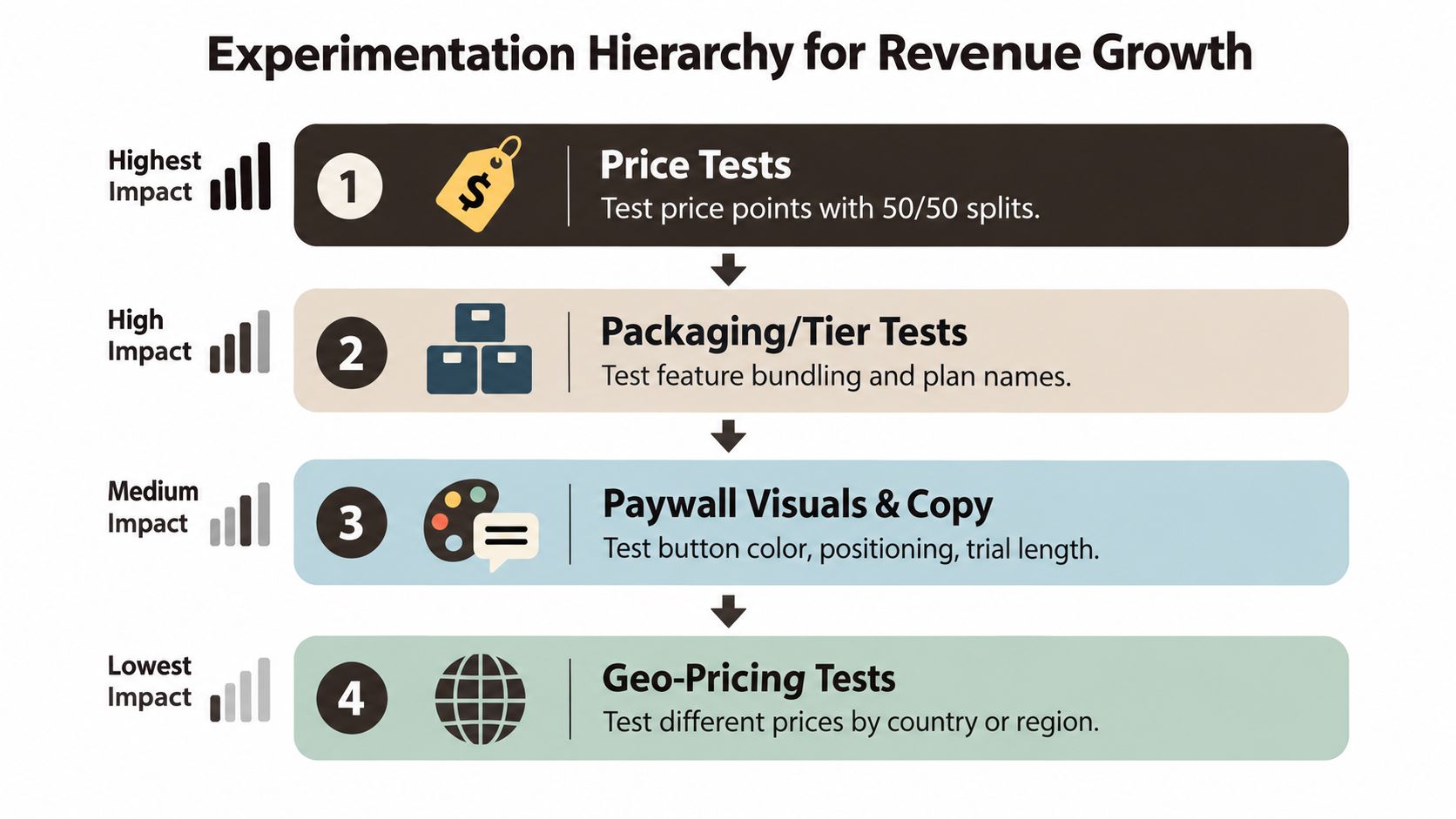 A hierarchy chart showing the order of experimentation strategies for business revenue growth from highest to lowest impact.
Test order matters
A smart testing hierarchy looks like this:
-
Price first
If the price point is wrong, better visuals won't fix the economics. -
Packaging next
Plan names, feature bundles, annual versus monthly emphasis, and trial structure often reshape perceived value. -
Paywall design after that
Copy, layout, default selection, and visual hierarchy still matter, but they usually amplify the offer rather than define it. -
Geo-pricing last
Useful, but lower impact than most founders expect.
That order is especially important when your team has limited engineering time.
How to run pricing tests without fooling yourself
The technical standard for pricing optimization is to randomize new users into 2 to 3 variants at signup, keep that assignment stable for each user, and run the test for at least one to two full billing cycles, often 30 to 60 days minimum for monthly plans, so you can measure not only conversion but also time-to-first-payment, first-month churn, revenue per customer, and LTV, according to this pricing experiments resource.
That point matters because short tests often produce false winners. A lower price can improve trial starts. A higher price can reduce top-of-funnel conversion but improve unit economics. If you stop too early, you optimize for excitement, not profit.
Track at least these outcomes:
- Initial conversion: Did users start paying?
- Time-to-first-payment: Did one variant delay revenue?
- First-month churn: Did the price create regret?
- Revenue per customer: Did the winner make more money?
- LTV trend: Are stronger users sticking around?
Don't declare a winning paywall based only on trial conversion. Revenue optimization cares about what users are worth after they start paying.
If you're also producing ad assets or creative variants around these tests, product teams often benefit from keeping creative operations simple. A tool such as Pricing for ad creatives can help clarify production overhead when testing acquisition messages alongside in-app monetization changes.
Price increases need guardrails
Founders often fear that any price increase will crush growth. Recent benchmark coverage suggests the effect is often milder than expected. It reports that the median subscription app saw only a 7 to 12% relative drop in trial-to-paid conversion after 20 to 30% price increases, while ARPU rose 18 to 24%. It also notes that users who were grandfathered for at least one billing cycle experienced 60 to 70% less incremental churn than users hit with immediate increases, based on this subscription app price increase benchmark coverage.
That doesn't mean “always raise prices.” It means test them carefully, isolate new users, and protect existing subscribers when possible. If you're exploring variable plans or metered offers, AppLighter's write-up on usage-based pricing is a practical reference for thinking through packaging before you touch the paywall UI.
Analytics and Cohort Analysis That Reveal Hidden Revenue Leaks
A blended revenue chart hides too much. It mixes strong cohorts with weak ones, masks bad billing behavior, and turns real problems into averages.
Cohort analysis fixes that by grouping users based on a shared starting point, then tracking what happens over time.
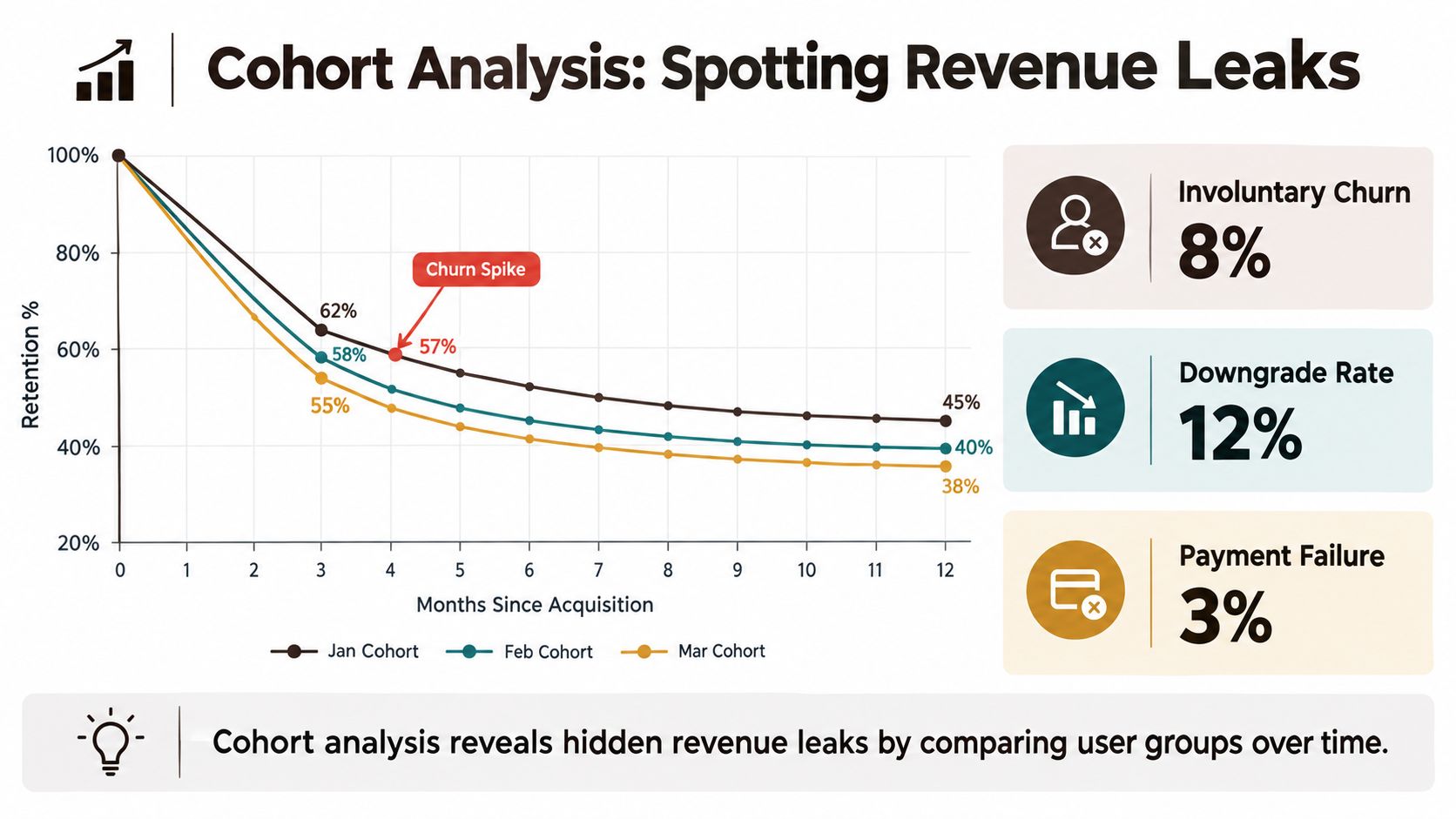 A cohort analysis line chart visualizing user retention trends and identifying revenue leaks over twelve months.
The cohorts that matter most
For indie app teams, three cuts usually reveal the most:
- Acquisition date cohort: Did users who joined after a product or paywall change retain better?
- Plan cohort: Do monthly subscribers behave differently from annual subscribers?
- Price variant cohort: Did the higher-price group produce more real value or just fewer checkouts?
You don't need a giant BI team to read these. Start with retention and revenue lines by cohort. If one group drops sharply after renewal, that's a clue. If one price variant converts less but earns more over time, that's another.
A useful way to train your eye is to watch a cohort walkthrough like this:
Separate voluntary churn from involuntary churn
Many mobile teams leave money on the table. They track cancellations but under-invest in failed payments.
Independent benchmark coverage notes that billing-failure recovery can be the highest-ROI retention work because the revenue was already earned. The same summary reports that weekly plans can lose about 65% of users in the first 30 days, while monthly plans also show meaningful early churn, according to this subscription apps benchmark summary for 2025 and 2026 coverage.
That tells you two things:
- Early retention deserves close cohort review.
- Payment recovery is not a side task. It's a core revenue lever.
So split churn into two buckets:
- Voluntary churn: The user canceled on purpose.
- Involuntary churn: The user intended to stay, but the payment failed.
If you don't separate those, your retention strategy gets distorted. You'll keep tweaking paywall copy when the actual problem is expired cards, failed renewals, or weak retry logic.
Instrument the events that answer real questions
For revenue optimization, the event schema matters as much as the charts. Track things like paywall_viewed, trial_started, initial_purchase, renewal_success, renewal_failed, cancellation, and restore_completed. Then join them to plan type, experiment assignment, and acquisition source.
This is one place where a wired stack helps. If you're shipping with AppLighter, the Expo frontend, edge-ready API layer, and preconfigured app architecture make it easier to add clean monetization events without rebuilding auth, navigation, or state plumbing first. For behavior instrumentation patterns, this guide to user behavior analysis is a solid companion.
A cohort chart is only as good as the events behind it. If trial starts and renewal failures aren't consistently tracked, the graph may look tidy while the business leaks revenue.
Your Revenue Optimization Checklist for React Native Teams Using AppLighter
Small teams need sequence more than ambition. Revenue optimization works when you line up the work in the right order and resist the urge to test everything at once.
A practical implementation order
Use this checklist:
- Instrument the core revenue events first. Track paywall views, trial starts, purchases, renewals, failures, cancellations, and experiment assignments.
- Pick one primary monetization model. Don't pile on subscriptions, ads, and one-off purchases unless each has a clear role.
- Create a pricing test backlog. List the first few price, package, and paywall hypotheses in priority order.
- Assign stable variants for new users. Keep each user in the same branch long enough to measure downstream behavior.
- Review cohorts every week. Segment by signup period, plan type, and variant.
- Build involuntary churn recovery flows. Failed billing deserves product attention, not just support attention.
- Protect existing users during price changes. Grandfathering often makes testing safer.
- Decide ownership. Even in a two-person team, one person should own revenue reporting and one should own implementation.
Verification checks before you ship
Before you call your setup “done,” confirm these basics:
- Events are consistent: The purchase event fires once, not twice.
- Plans are identifiable: You can tell monthly from annual in analytics.
- Experiments are readable: Each cohort can be tied back to a variant.
- Renewal failures are visible: You can spot them without digging through logs.
- Dashboards answer decisions: Every chart should support a real product choice.
The point isn't to build a giant monetization machine. It's to stop guessing. Once your stack is wired correctly, you can treat revenue optimization as a repeatable operating habit instead of a launch-week scramble.
AppLighter gives React Native teams a production-ready Expo stack with the app architecture already wired up, which makes it easier to implement subscription flows, analytics events, and the API patterns that revenue optimization depends on. If you want to spend less time assembling boilerplate and more time testing pricing, reading cohorts, and fixing revenue leaks, take a look at AppLighter.