10 Cost Reduction Strategies for Mobile App Teams
Explore 10 cost reduction strategies for mobile app teams, covering scope, templates, architecture, automation, staffing, vendors, and sustainable measurement.
 Parth
Parth
The most popular cost-cutting advice for mobile startups is often the least useful: reduce headcount, choose the cheapest vendor, and ship fewer quality checks. Those moves can lower a visible line item while increasing rework, outages, missed releases, and customer churn. Cost reduction isn't about shrinking capability. It's about removing waste from the system that creates and operates the product.
A stronger approach starts before code is written. Validate scope early, reuse stable foundations, choose an architecture that matches actual demand, automate repeatable delivery, and evaluate vendors by total cost of ownership rather than purchase price. Bain's research found that 40% of executives attempting to cut costs by at least 10% failed to reach their target, while nearly 60% of companies pursuing reductions of 20% or more reported failure. The same research points to external market data, strategic alignment, meaningful metrics, and cross-functional analysis as recurring features of durable reductions in Bain's cost transformation research.
The ten strategies below move in that order. They cover product scope, starter architecture, cross-platform delivery, AI-assisted development, infrastructure, backend services, distributed teams, open source, CI/CD, performance, and technical-debt control. The practical question isn't “What can we cut?” It's “Which decision removes recurring effort without creating a larger liability later?”
Table of Contents
- 1. Leverage Starter Kit Templates and Boilerplates
- 2. Use Cross-Platform Development with React Native
- 3. Apply AI-Assisted Development and Code Generation
- 4. Match Microservices and Serverless Architecture to the Workload
- 5. Adopt Managed Backend Services Carefully
- 6. Build Distributed Developer Teams Around Process
- 7. Use an MVP and Lean Development Approach
- 8. Select Open Source and Free Tools with Ownership in Mind
- 9. Automate CI/CD and Release Operations
- 10. Manage Performance and Technical Debt as Operating Costs
- 10 Cost-Reduction Strategies Compared
- Turn Savings Into an Operating System
1. Leverage Starter Kit Templates and Boilerplates
Foundational work is necessary, but it doesn't always need to be original. Authentication flows, navigation, state management, API clients, environment configuration, error handling, and responsive UI foundations appear in many mobile products. Rebuilding each one from a blank repository consumes time before the team has learned whether the product deserves further investment.
A production-oriented starter kit can turn those repeated decisions into a reviewed baseline. AppLighter, for example, is built around Expo and React Native, with authentication, navigation, state management, AI integrations, and an edge-ready Hono and TypeScript API layer already connected. That doesn't eliminate implementation work, but it lets a team spend its early effort on the product's differentiating behavior.
The relevant comparison isn't template price versus zero. It's reusable foundation versus repeated engineering and review effort. A template can create debt if its assumptions conflict with your stack, its integrations are abandoned, or your team can't explain how its core pieces work.
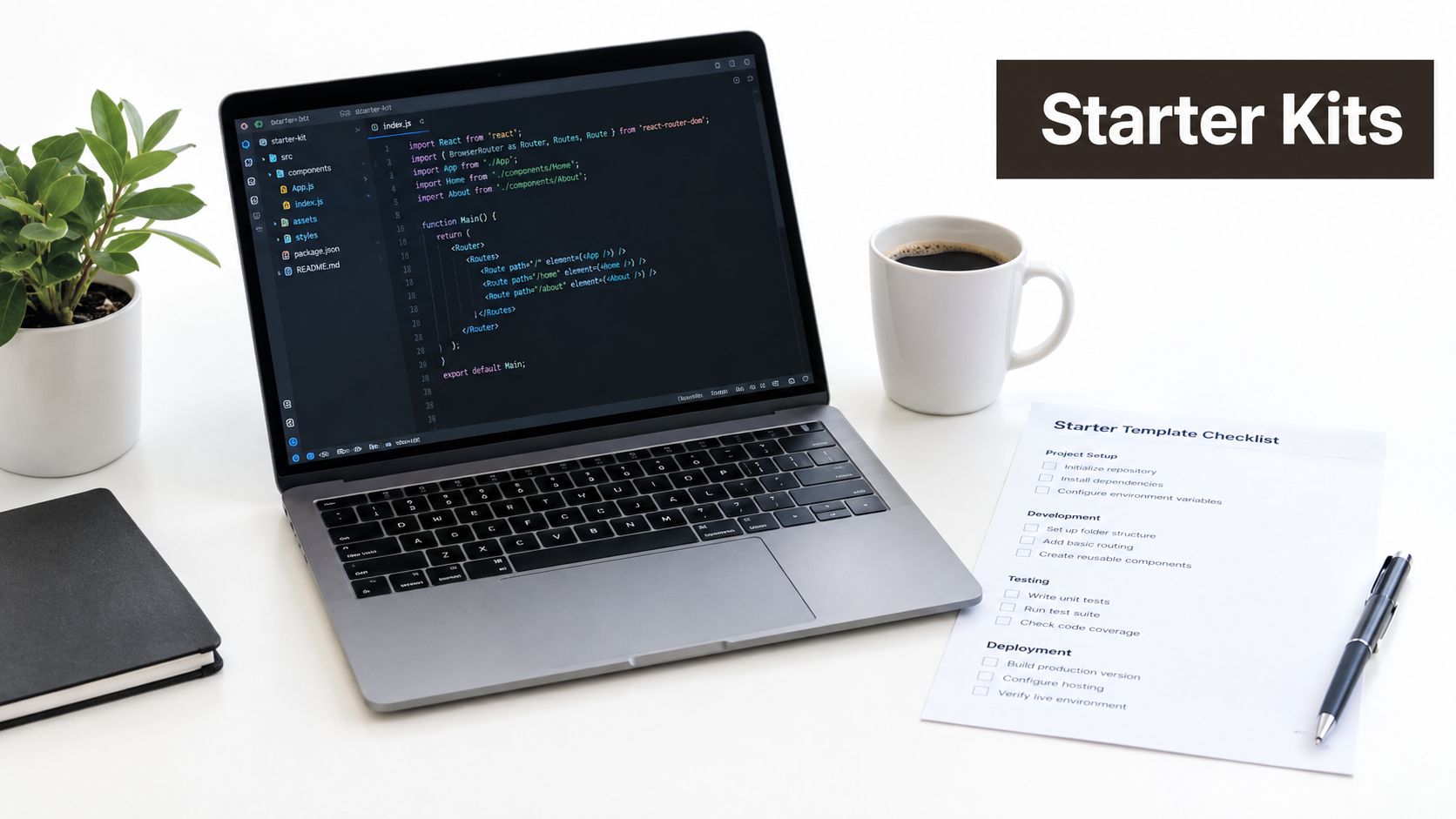 A laptop showing React code next to a coffee mug and a starter template checklist on desk.
Choose the foundation deliberately
Before adopting a boilerplate, inspect its data model, build process, authentication boundaries, testing conventions, and upgrade path. Confirm that required integrations, such as payments or AI services, fit your security and deployment model. You should also budget time for onboarding developers who didn't create the original structure.
Use the React Native and Expo starter kit guidance as a reference point, but make the final decision against your product requirements. A useful safeguard is to build one representative feature, including its tests and deployment path, before migrating the entire app.
2. Use Cross-Platform Development with React Native
Separate iOS and Android codebases create separate implementation paths, review cycles, release processes, and defect inventories. For many mobile teams, React Native offers a way to share product logic and UI primitives while still allowing native code where platform behavior differs.
The saving comes from reducing duplicated work, not from pretending the platforms are identical. A shared component library can cover common screens, form behavior, validation, analytics, and network access. Platform-specific code can remain explicit for permissions, notifications, deep links, background tasks, accessibility behavior, and interaction patterns that users expect to feel native.
Expo can simplify builds and development workflows, particularly for teams that don't want to manage native configuration for every change. Teams can also extend a shared React Native application toward web when the product's interaction model supports it. That can be valuable for internal tools, account management, or lightweight customer workflows, but it shouldn't force a mobile experience into an unsuitable browser interface.
Protect the shared codebase from false economy
Start by classifying features as shared, adapted, or native. Design the shared layer around stable domain behavior and reusable components, not around the lowest common denominator. Keep platform detection close to the feature that needs it, and test both platforms throughout development rather than postponing compatibility work until release.
A single codebase can still produce expensive problems if the team ignores platform edge cases. Review memory use, keyboard behavior, navigation conventions, store policies, and device-specific performance as part of definition of done. The right question is whether shared implementation reduces total ownership effort while preserving the quality users notice.
3. Apply AI-Assisted Development and Code Generation
AI coding tools are most useful where the work is repetitive, well specified, and easy for a human to verify. Developers can use them to draft typed interfaces, test cases, documentation, migration scripts, mock data, and routine React components. They can also help explain unfamiliar code and propose debugging paths, but generated output still requires ownership.
A six-month enterprise pilot with 430 engineers reported 78% adoption, 22% acceptance, and 76% developer satisfaction for GitHub Copilot, with users saving an average of 10 hours per week. The same benchmark reported 39% adoption, 11% acceptance, and 64% satisfaction for Amazon Q, showing that realized value depends on workflow integration and tool fit. These figures come from the enterprise comparison of GitHub Copilot and Amazon Q, and they shouldn't be treated as a guaranteed result for a startup.
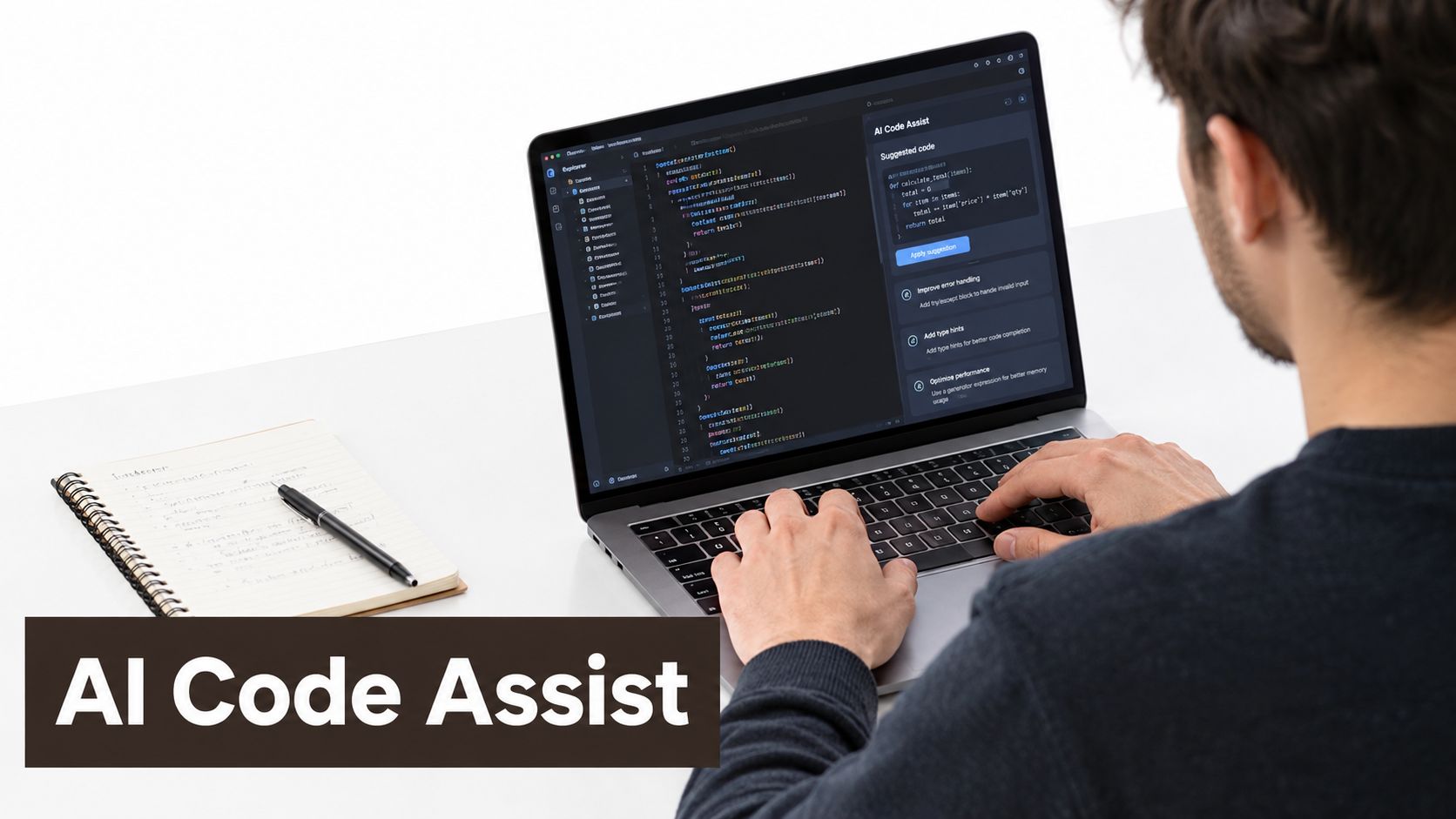 A professional developer writing code on a laptop with an AI code assistant tool displayed on screen.
Give AI bounded work
Begin with tasks where the acceptance criteria are concrete. Ask the tool to generate tests for an existing function, document an API contract, or produce a first draft of a component that follows an established pattern. Keep secrets, customer data, and sensitive business logic out of prompts unless your organization's controls explicitly allow that use.
Human review remains the control point: Generated code must pass the same review, security, test, and observability standards as code written without assistance.
Teams using Claude, Cursor, or GitHub Copilot should define repository rules, preferred libraries, error-handling conventions, and testing expectations. AppLighter's AI code generation tools guide can help teams think through that setup. Measure accepted changes, review time, escaped defects, and rework. If the tool produces plausible but incompatible code, the apparent speed is not a saving.
The video below offers another practical perspective on AI-assisted development workflows.
4. Match Microservices and Serverless Architecture to the Workload
Serverless functions and small services can reduce the amount of infrastructure a mobile team manages directly. A team can deploy a focused API endpoint without maintaining a permanently provisioned application server, and usage-based execution can fit workloads that are intermittent or difficult to forecast.
That doesn't make serverless automatically cheaper. Function invocations, database traffic, logs, egress, queues, observability, and vendor-specific services all contribute to the bill. A fragmented microservice architecture also increases deployment coordination, debugging complexity, permissions management, and local development overhead. For an early product, a modular monolith may be cheaper to understand and change.
Use serverless where its operational model matches the request pattern. Short-lived API operations, webhook handlers, scheduled jobs, image processing, and low-frequency administrative actions are often reasonable candidates. Keep latency-sensitive paths, long-running workflows, and tightly coupled transactions under closer architectural review.
Set boundaries before splitting services
Define ownership, contracts, failure behavior, and local testing for each service. Monitor cold starts and downstream latency from the beginning, especially when a mobile screen depends on several sequential calls. Cache stable responses, reduce unnecessary function calls, and place edge execution near users only when the latency benefit justifies the added platform complexity.
A Hono-based edge-ready API can provide a lightweight foundation, but the team still needs budgets and alerts for invocation volume, database usage, and log retention. The safeguard is simple: compare the proposed design with a well-structured single service using total operating effort, not infrastructure diagrams.
5. Adopt Managed Backend Services Carefully
Managed backend services can remove undifferentiated infrastructure work from a small team. Authentication, database hosting, object storage, API access, backups, and operational dashboards are available without building each capability internally. Supabase is one example that combines managed services with an open PostgreSQL foundation, which can make familiar SQL workflows attractive to React Native teams.
BaaS is particularly useful when the product needs a working backend quickly and its data model fits the platform's strengths. An indie developer or small product team may be able to deliver a complete workflow without staffing a separate backend function immediately. That benefit is real, but it shouldn't be confused with eliminating backend responsibility. Someone still owns authorization, schema quality, query performance, migrations, backups, and incident response.
Price the exit as well as the entry
Review pricing at the usage level your product could reach, including database operations, storage, bandwidth, authentication, functions, backups, and support. Avoid putting sensitive authorization decisions only in client code. Use row-level security for tenant boundaries, define database indexes intentionally, and inspect slow queries before they become a recurring operational cost.
Document the services that are proprietary to the platform and the data export path. Keep business rules in a portable domain layer where practical, rather than scattering them across triggers and vendor-specific functions. If the product outgrows the service, a migration plan should describe data extraction, compatibility testing, downtime risk, and the people who'll execute it.
6. Build Distributed Developer Teams Around Process
Distributed hiring can expand access to capable developers and align staffing with a startup's budget. The cost advantage isn't produced by geography alone. It depends on communication quality, technical leadership, documentation, overlap for important decisions, and a review system that makes expectations visible.
A low hourly rate can become expensive when requirements are ambiguous, handoffs are incomplete, or senior engineers spend their time repairing integration work. Distributed teams also face risks around security access, employment arrangements, intellectual property, and continuity when a contractor leaves. Treat those risks as operating costs, not administrative details.
Standardize the work, not the people
Give every contributor the same repository setup, coding standards, issue templates, environment instructions, branch rules, and definition of done. Use a starter architecture where it helps reduce variation, but don't use a template as a substitute for technical direction. Pair written requirements with small acceptance examples so asynchronous work can move without constant meetings.
- Vet through representative work: Ask candidates to explain trade-offs in a task that resembles the product, not just complete a trivia exercise.
- Make ownership explicit: Assign a person to each feature, service, release path, and operational area.
- Use review as a learning system: Require tests, security checks, and clear pull request descriptions, then look for repeated defects rather than blaming individuals.
- Design for asynchronous progress: Record decisions, keep API contracts current, and reserve synchronous time for ambiguity or incidents.
For teams looking to staff specific engineering capabilities, forward-deployed engineering opportunities from We Are Distributed provide one example of the market to evaluate. The decision should rest on reliability, communication, and total delivery cost, not location alone.
7. Use an MVP and Lean Development Approach
The cheapest feature is often the one the team doesn't build. An MVP should answer a meaningful product question with the smallest reliable workflow, rather than act as a reduced version of the entire roadmap. That means defining the user, the problem, the success signal, and the evidence that would justify more investment.
For a mobile app, the first release might include one core action, account access, essential analytics, support contact, and enough reliability to observe real use. It may not need a complex notification system, multiple payment tiers, elaborate personalization, or a fully generalized settings area. Removing speculative scope protects engineering capacity and shortens the distance between an assumption and user feedback.
Make learning part of the architecture
Instrument the core journey before launch. Use feature flags to release risky behavior selectively, and keep analytics events tied to decisions the team expects to make. Feedback should come from observed usage, support conversations, interviews, and retention patterns, not only from internal preference.
A lean approach can create technical debt when speed becomes an excuse for unowned shortcuts. Record deferred work, name the consequence, and set a condition for revisiting it. A temporary local workaround may be acceptable for a validation build. An insecure authorization model or untestable data migration isn't.
Scope reduction is safe when it removes uncertainty. It becomes dangerous when it hides quality problems.
Review the MVP after each learning cycle. Promote validated workflows into stronger abstractions, delete experiments that no longer matter, and resist preserving every prototype decision because code already exists.
8. Select Open Source and Free Tools with Ownership in Mind
Open-source software can reduce licensing expense and give a team access to mature building blocks. React Native, Expo, TypeScript, Hono, and Supabase are examples of technologies that can support mobile products without requiring a proprietary foundation for every layer. The direct license cost is only one part of the decision.
A library also carries maintenance, security, compatibility, and upgrade obligations. A project with weak release discipline can force your team to maintain a fork. A free hosted tier can change its limits or create a migration problem when usage grows. Teams should evaluate the cost of stewardship before replacing a paid tool.
Create an inventory, not a pile
Track each dependency, its license, maintainer activity, release history, security notices, transitive dependencies, and role in the application. Pin versions where reproducibility matters, but schedule upgrades so the team doesn't accumulate an unmanageable jump. Run dependency and secret scanning in CI, and remove packages that duplicate capabilities already present in the platform.
- Prefer established interfaces: Choose libraries with clear documentation and stable integration patterns.
- Check operational fit: Confirm that logging, backups, monitoring, and support remain adequate for production.
- Plan contribution or replacement: If the team depends on a critical project, decide whether it can contribute fixes or maintain an internal alternative.
- Separate free from costless: Include engineering time, hosting, security review, and migration effort in the evaluation.
Open source works best when it strengthens control over the product's core rather than adding an unmanaged collection of dependencies.
9. Automate CI/CD and Release Operations
Manual builds and deployments consume senior attention at exactly the point when mobile teams need repeatability. A CI/CD pipeline can run tests, linting, type checks, security scans, preview builds, and release steps consistently. It also creates a record of what changed and which checks passed before an artifact reached users.
Start with the critical path, not an elaborate platform. Run unit and integration tests for authentication, payments, data synchronization, and other failure-sensitive flows. Build the app in a clean environment, store signing credentials securely, and separate staging from production. For Expo-based React Native applications, Expo EAS can support repeatable build and submission workflows, while GitHub Actions or GitLab CI/CD can orchestrate repository checks.
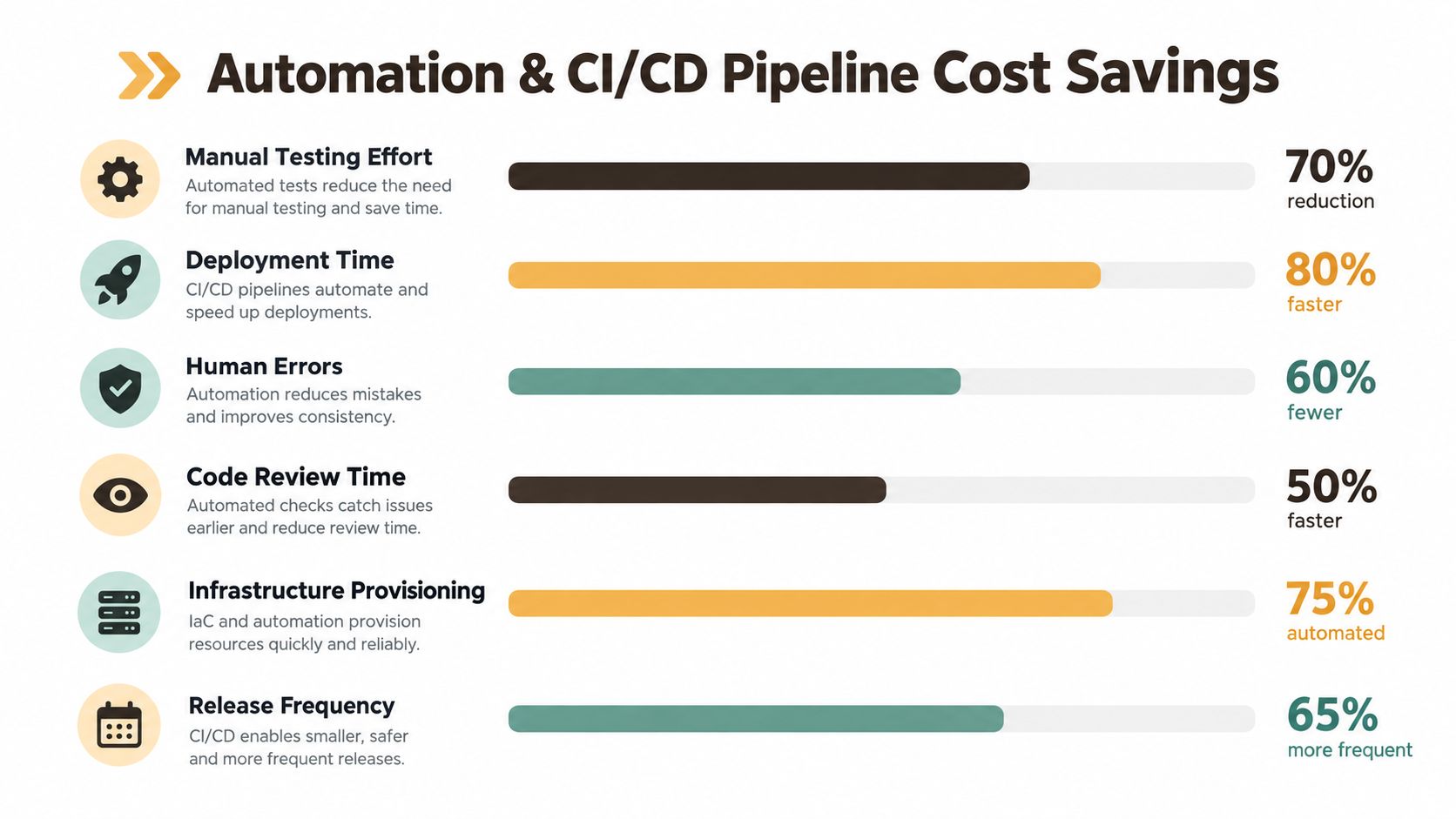 An infographic illustrating various cost reduction strategies and benefits of implementing automation and CI/CD pipelines in software development.
Automate the expensive mistakes first
A pipeline that runs quickly but provides weak protection isn't a cost reduction. Define which checks block a merge, which failures page someone, and which checks provide feedback without stopping delivery. Add feature flags and staged rollout controls so a successful build doesn't automatically expose every user to an unverified change.
Keep an eye on build minutes, cache effectiveness, artifact retention, and failed reruns. A mobile CI/CD implementation guide can help organize the workflow, but the team should measure whether automation reduces waiting, manual intervention, rollback effort, and escaped defects.
The second saving comes from fewer interruptions. When releases are reproducible, developers spend less time reconstructing local environments and investigating whether a deployment was performed correctly.
10. Manage Performance and Technical Debt as Operating Costs
Performance work is often postponed because it doesn't appear in a feature request. That decision can shift cost into support, infrastructure, rework, and lost product trust. A mobile team should treat startup time, screen responsiveness, bundle size, memory use, network behavior, and battery impact as product constraints.
Set performance budgets for the flows that matter most. Use React DevTools and profiling tools to find unnecessary renders, inspect bundle composition, compress and appropriately size images, and measure database queries rather than guessing at their impact. Monitor real devices and realistic network conditions, because a fast simulator doesn't represent every customer.
Make debt visible and conditional
Not every shortcut deserves immediate cleanup. Classify debt by risk, interest, and affected user journey. A temporary abstraction that speeds up a validated experiment may be reasonable. Duplicated authorization logic, an unbounded query, an unowned dependency, or a fragile release script deserves earlier attention because it can multiply future work.
Debt needs a trigger: Tie cleanup to a measurable event, such as a feature touching the same module, a performance budget breach, or a recurring production defect.
Review technical debt during planning, not only during emergencies. Include rework, defect investigation, build failures, support volume, and operational incidents in the cost picture. Performance improvements should be verified against those measures, not declared successful because a local benchmark looks better.
10 Cost-Reduction Strategies Compared
| Strategy | Complexity (🔄) | Resources (⚡) | Expected Outcomes (📊) | Ideal Use Cases (💡) | Key Advantages (⭐) |
|---|---|---|---|---|---|
| Leverage Starter Kit Templates & Boilerplates | 🔄 Low–Medium, quick setup, learn template structure | ⚡ Low, template + minimal infra | 📊 ~40–60% dev time reduction; faster onboarding | 💡 Rapid MVPs, multi-client projects, fast prototyping | ⭐ Fast time-to-market; built-in best practices |
| Cross-Platform Development with React Native | 🔄 Medium, cross-platform edge cases & tuning | ⚡ Medium, JS/TS devs, Expo tooling | 📊 ~50–70% cost/maintenance reduction vs native | 💡 Apps targeting iOS, Android, web from one codebase | ⭐ High code reuse; lower hiring needs |
| AI-Assisted Development & Code Generation | 🔄 Medium, integration + prompt engineering | ⚡ Low–Medium, AI services, tooling, training | 📊 ~25–40% faster velocity; 30–50% boilerplate automated | 💡 Boilerplate generation, code review, junior support | ⭐ Speeds development; improves repetitive-task quality |
| Microservices & Serverless Architecture | 🔄 Medium–High, design, monitoring, cold starts | ⚡ Low ops but needs cloud services & observability | 📊 ~40–60% ops cost reduction; elastic scaling | 💡 Variable workloads, APIs, edge-low-latency endpoints | ⭐ Auto-scaling; eliminates server maintenance |
| Managed Backend Services & BaaS | 🔄 Low, minimal infra setup, platform lock considerations | ⚡ Low, managed DB/auth/storage services | 📊 ~50–70% backend dev & ops cost reduction | 💡 Startups, indie apps, teams without backend engineers | ⭐ Fast backend features (auth, backups, realtime) |
| Offshore & Distributed Developer Teams | 🔄 Medium–High, coordination, QA and culture overhead | ⚡ Low-cost labor + collaboration tools | 📊 ~40–70% salary savings; potential 24/7 development | 💡 Cost-sensitive scaling, access to global talent | ⭐ Significant salary savings; broader talent pool |
| MVP & Lean Development Approach | 🔄 Low–Medium, requires strict scope discipline | ⚡ Low, small teams, analytics, rapid deploy | 📊 ~50–80% reduction in initial development costs | 💡 Early-stage validation, feature prioritization | ⭐ Low initial spend; faster user feedback loop |
| Open Source & Free Tools Integration | 🔄 Medium, vetting, maintenance responsibility | ⚡ Low, no licensing fees, community support | 📊 ~30–50% savings on licensing/vendor costs | 💡 Budget-conscious projects, customizable stacks | ⭐ No vendor lock-in; full source transparency |
| Automation & CI/CD Pipeline Implementation | 🔄 Medium–High, initial setup & maintenance | ⚡ Medium, CI infra, test suites, infra-as-code | 📊 ~60–80% reduction in manual testing/deploy effort | 💡 Teams shipping frequently; reliability-focused projects | ⭐ Faster, more reliable releases; fewer human errors |
| Performance Optimization & Technical Debt Management | 🔄 Medium–High, ongoing effort & discipline | ⚡ Medium, profiling tools, expert time | 📊 Improves retention (≈5–10% per 100ms); reduces infra costs | 💡 Scaling apps, performance-critical products | ⭐ Long-term cost savings; better user experience |
Turn Savings Into an Operating System
Ten cost reduction strategies won't help if they remain a list of disconnected ideas. The durable approach is to connect each saving to a decision, an owner, a metric, and a safeguard. A starter kit affects foundation work. React Native affects codebase boundaries. AI tools affect review and quality controls. Serverless and BaaS affect operating models and vendor exposure. Distributed teams affect documentation and ownership. Lean scope affects what the company chooses not to build.
Begin with a baseline. Separate development effort, infrastructure usage, build and test consumption, software licenses, vendor contracts, support work, defect rework, and technical-debt work. Don't rely only on purchase price. Guidance on cost reduction beyond purchase price highlights hidden fees, contract terms, service levels, downtime, and long-term operating costs. Deloitte's guidance cited there says organizations should assume 20% to 25% of targeted savings can be lost to friction, while implementation can cost $0.20 to $0.90 per dollar saved. Those figures reinforce the central discipline: measure realized savings after adoption and disruption, not the projected saving on a proposal.
Choose a small intervention set
Don't launch every initiative at once. Select a few actions that address the largest recurring sources of waste and can be measured without creating a reporting project. For example, a team might standardize its starter architecture, automate its release pipeline, and remove unused vendor capacity before changing its staffing model.
Assign one accountable owner to each intervention. That owner should define the starting point, expected behavior, review date, and rollback condition. If a new BaaS provider lowers setup effort but creates unacceptable query latency, the team needs a decision rule before sunk effort makes the choice difficult to reverse.
Track delivery time, build and test effort, infrastructure usage, license spend, defect rework, performance budgets, release failures, and completed technical-debt work. Review trends regularly and investigate changes after major launches, architecture changes, or vendor renewals. Cost visibility should help product and engineering make better trade-offs, not pressure teams to hide necessary work.
Bain's findings also support this systems view. Durable reductions came from external market data, strategic alignment, meaningful metrics, and attention to cross-functional seams rather than isolated departments. McKinsey's global cost-cutting survey found that just over half of respondents used targeted reductions focused on a geography or function, while 44% pursued across-the-board cuts, as reported in McKinsey's survey results. For a mobile startup, targeted action usually means protecting discovery, reliability, and customer-facing quality while removing duplicated delivery and operating effort.
Finally, evaluate AI costs as part of the full workflow. If you're comparing agentic development tools, token loop pricing explained can inform the tooling discussion, but usage price alone won't tell you whether the tool improves outcomes. Compare accepted work, review burden, defects, context-management effort, and integration with the team's existing process.
The objective is not the lowest possible spend. It's a product system that can ship useful changes, operate reliably, and explain where money goes. When teams review cost as part of normal engineering management, savings become repeatable instead of temporary.
AppLighter provides an Expo and React Native starter kit with connected authentication, navigation, state management, AI tooling, and an edge-ready API foundation. If you want to reduce repeated setup work while keeping architecture and delivery decisions visible, visit AppLighter and evaluate whether its foundation fits your next mobile product.