Technical Debt Management for Startup MVPs
Learn technical debt management for React Native MVPs: measure principal and interest, prioritize by product risk, and decide what to pay down.
 Parth

A million line system can carry $306,000 a year in technical debt, and that number should change how you think about your MVP. You're not arguing about clean code. You're deciding how much future delivery time you're willing to borrow today, and whether you'll ever pay it back on purpose.
Table of Contents
- Why Technical Debt Management Changes Delivery Speed
- What Technical Debt Is and Where It Comes From
- How to Measure Technical Debt and Keep a Register
- How to Prioritize Debt by Product Risk
- A Release Workflow That Repays Debt on Purpose
- Technical Debt Tactics for React Native and AI Builds
- When to Accept Debt and What to Do Next
Why Technical Debt Management Changes Delivery Speed
You ship the first version fast. A founder demo needs onboarding, payments, and a feed by Friday, so you copy a screen, stash the same user object in three places, and hard code the API response shape the backend sent you in a chat message.
Two months later a simple settings screen takes longer than the original feed. One navigation change breaks deep links. A state fix for iOS creates a flicker on Android. Nobody trusts the tests around checkout, so every release needs manual checks on both platforms.
That's not a discipline problem. It's technical debt management missing from planning.
Debt Is Borrowed Capacity
Good technical debt management means you record each shortcut as a liability, estimate what it'll cost later, name an owner, and schedule repayment beside feature work. The 2023 Sonar analysis of more than 200 projects put scale to this, estimating approximately $306,000 annually and about 5,500 developer hours for a 1 million line codebase, rising to roughly $1.5 million and approximately 27,500 hours over five years.
Your React Native app is smaller, so the dollars are lower. The mechanism isn't. Interest shows up as slower releases, flaky cross platform bugs, longer onboarding for a second developer, and time stolen from the feature that decides whether users stay.
Speed without a repayment plan doesn't remove the delay. It moves the delay to a worse moment, usually right after launch when users are watching.
Small teams feel this earlier because there's no spare engineer to absorb it. If one person knows why auth state resets on refresh, that person becomes support, release manager, and bottleneck. Founders working out sequencing can use UAE startup product strategy as context for tying those engineering tradeoffs to product bets, not just sprint output.
My recommendation is blunt. Don't ask engineers whether debt exists. It does. Ask what you borrowed, what interest you're paying, and which repayment protects the next release. If you can't answer that in planning, you don't have a velocity problem yet. You have an invisible tax compounding in your backlog.
What Technical Debt Is and Where It Comes From
Technical debt became an established concept in 1992, when Ward Cunningham introduced the metaphor while describing the WyCash portfolio management system in the account of Cunningham's 1992 WyCash work. A shortcut borrows development effort. You ship working software sooner, but future changes cost more until you refactor the design underneath it.
That's the useful part of the metaphor. Limited, tracked debt can speed delivery. Unmanaged debt charges interest through slower changes, extra complexity, and rising maintenance.
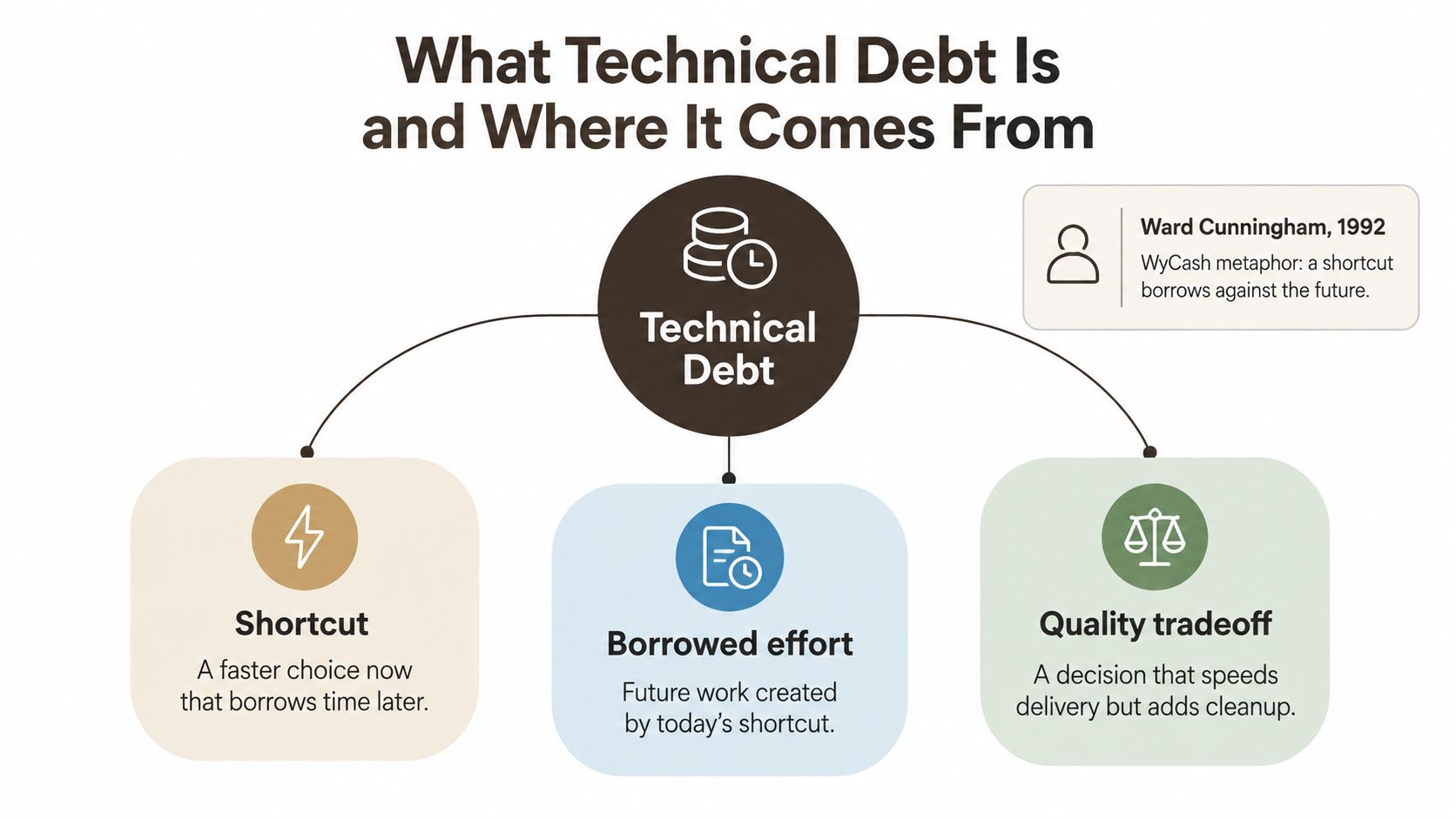 A diagram explaining technical debt, showing origins like shortcuts, borrowed effort, and quality tradeoffs in software development.
A Loan Is Not a Broken Lock
A bug is incorrect behaviour. The lock is broken, you fix it. Debt can work correctly today and still be a poor trade. It's a conscious, or careless, compromise in architecture, design, testing, documentation, or implementation quality.
You'll create it in recognisable ways:
- Deliberate debt: You stub analytics for a launch, write down the missing events, and accept the gap for one release.
- Accidental debt: You copy a profile screen to make an edit screen, then both copies drift and fixes land in only one place.
- Bit rot debt: A library, API contract, or platform pattern moves on while your code stays put, so a once reasonable choice gets expensive.
Mobile teams add their own sources. You skip tests around payments because the happy path works on your phone. You let each screen fetch its own data instead of sharing a client. You accept AI generated components without checking whether they duplicate state logic you already have. You document nothing about why auth was stubbed, so the next developer treats a temporary hack as the intended design.
Dependencies make those choices spread. Reading up on dependency management for AI teams is useful context here, because a shortcut rarely stays inside one file once other screens and services start relying on it.
Use this vocabulary in standup. Saying "we're taking deliberate debt in notifications, with an owner and a removal ticket" leads to a decision. Saying "the code is messy" leads to a style argument nobody can fund.
How to Measure Technical Debt and Keep a Register
Stop reporting debt as a giant issue count. A planner can't fund "many warnings." You need two numbers on the ticket, even if they're rough.
Principal is the estimated effort to remove the issue. Interest is the extra effort every future change keeps paying while it stays.
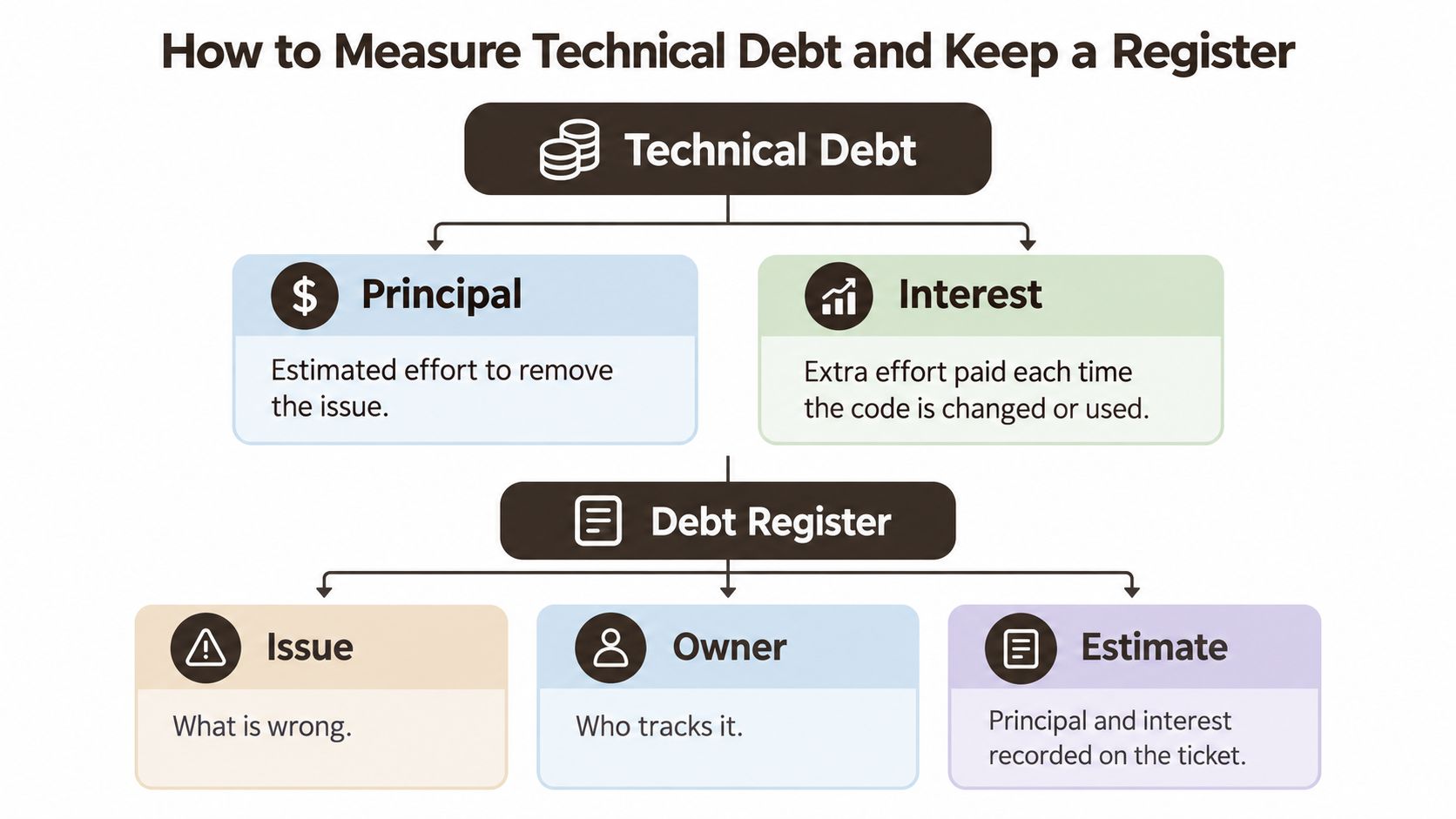 A diagram illustrating the concepts of technical debt, its principal and interest, and a debt register.
Estimating Principal and Interest
Approximate principal from remediation estimates, including static analysis findings and the engineer's own breakdown of the fix. Approximate interest from maintenance time, code churn, complexity, coupling, cohesion, and size. An empirical study described in research on principal and interest measures for technical debt found that classes with similar principal levels generally show similar interest, and that aggregated measures identify hotspots more reliably than isolated metrics.
That finding matters for a small team. Don't chase the file with the most lint warnings. Rank components with high coupling, large size, and high complexity first, then check that ranking against how often the code changes and how often it breaks. If you want the underlying measurement vocabulary, work through these code quality metrics for mobile codebases before you build your register.
One Row Per Liability
Keep the register where planning happens, not in a forgotten spreadsheet. Each row needs:
- Component and type: Name the module, screen, service, or test gap, and whether it's architecture, testing, documentation, or implementation debt.
- Owner and principal: One person tracks it, with a remediation estimate in hours or days.
- Interest signal: Note slow changes, repeat defects, manual release checks, or onboarding confusion.
- Risk context: Record change frequency, defect history, security exposure, and the target release for repayment.
Practical rule: If a debt item has no owner and no interest signal, it isn't managed debt. It's a complaint waiting for a crisis.
Review the register in planning, next to features. You're building a repayment queue aimed at recurring cost, not a trophy for the largest linter total. A duplicated API client touched every week beats a tidy formatting fix in a screen you haven't opened since launch.
How to Prioritize Debt by Product Risk
Reserving a fixed slice of every sprint sounds responsible, and it still doesn't tell you what to fund. You'll spend that slice on whatever an engineer dislikes most, not whatever protects users or revenue.
The tradeoff is already eating real time. A 2025 developer survey on time spent on technical debt and legacy work reported engineers spend roughly 2 to 5 working days per month, up to 25% of working time, on technical debt and legacy system activities. On a two person team, that's a serious part of your month gone before roadmap work starts.
Interest Bearing Versus Contained
Sort every item into one of two classes. Interest bearing debt slows every future change because it sits in shared, frequently touched code. Contained debt is isolated, stable, and cheap to work around.
Judge them together, not by gut feel:
- Probability and blast radius: How likely is failure, and how many users, screens, or services does it take down?
- Security exposure: Does it touch credentials, payments, personal data, or API permissions?
- Change pressure: Are the next product bets going to touch this module repeatedly?
- Human cost: Does it slow onboarding or make one developer the only safe pair of hands?
Which Technical Debt to Fund First
| Debt class | Signals to check | Default for an MVP | Mobile example |
|---|---|---|---|
| Interest bearing | High churn, repeat defects, wide blast radius | Fund before the next dependent feature | Shared auth state copied across navigation stacks |
| Interest bearing | Security exposure or revenue path involved | Fund now, even if it delays a feature | Untested payment retry logic |
| Contained | Low change frequency, isolated module, workaround is cheap | Accept with owner and review date | Awkward styling helper on a rarely edited help screen |
| Contained | No user or data risk, next bets don't touch it | Defer and monitor | Manual copy update in a static onboarding panel |
For an app startup, authentication, payments, data migrations, analytics, and API contracts come ahead of low change UI polish. Failures there hit users, revenue, or your ability to move later.
Change the question in planning. Don't ask how much debt is acceptable. Ask which debt will constrain the next three product bets. That framing lets you defer low risk shortcuts candidly, without pretending every cleanup deserves the same money.
A Release Workflow That Repays Debt on Purpose
Treat debt as a small portfolio inside the same backlog as features. If repayment lives in a separate list labelled "someday," product pressure will bury it every single release.
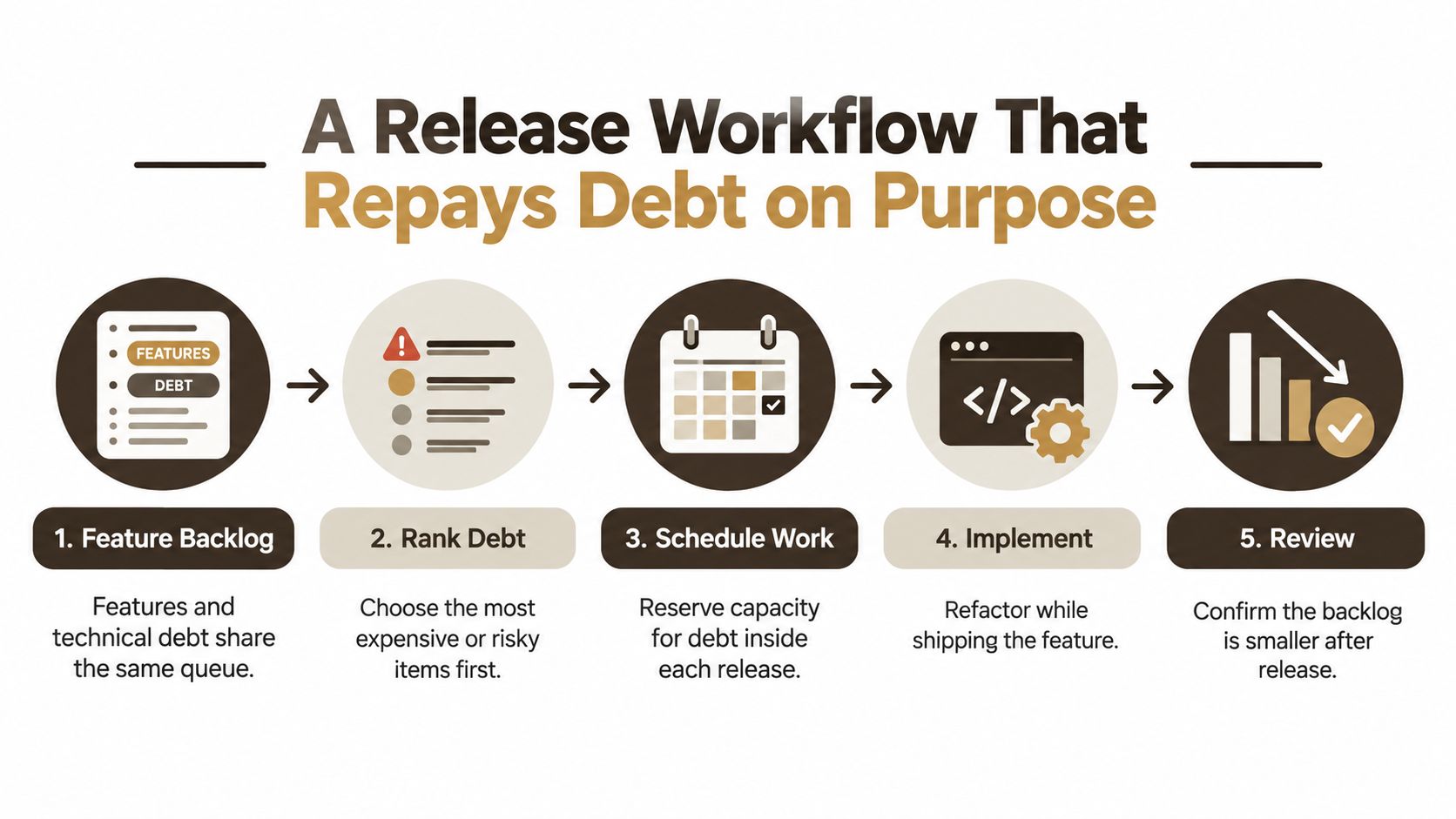 A five-step workflow diagram illustrating a process for intentionally managing and repaying technical debt in software development.
The Loop Inside Each Release
Run the same loop every iteration:
- Pull from the register: Start planning with the highest-impact rows beside feature tickets, each with an owner and a clear definition of done.
- Decide in the room: Accept, defer, or fund each item during sprint planning. Don't let deferral happen by silence.
- Check at review: Code review confirms ownership, tests, and dependency limits, and asks whether the change creates a new liability.
- Gate with CI: Tests run before merge, so repayment doesn't depend on someone remembering a manual checklist.
- Close the loop: At release, record what was repaid and what interest should now drop.
Reserve capacity beside feature work. That doesn't mean a rigid quota in every sprint. It means you name the repayment in the release commitment, the same way you'd name a feature, so a slipped cleanup is visible instead of absorbed without notice.
For the hands on part, study practical guidance on how to refactor code safely and apply it to hotspots on a set cadence, not only during crises. Small, frequent repayment in modules you're already touching beats a heroic rewrite after delivery stalls.
Watch the Portfolio, Not the Noise
Track principal, a simple debt ratio, churn, defects, and repayment throughput per release. A longitudinal analysis covered in research on technical debt concentration across releases found approximately 20% of issue types generated around 80% of total measured debt, so attack dominant categories, not every warning your tools print.
A rising debt ratio plus longer time to change a module means interest is eating capacity, even if feature output still looks stable this month.
That warning should trigger a funding conversation, not a blame conversation. You're correcting a portfolio that's drifting out of balance.
Technical Debt Tactics for React Native and AI Builds
Generic advice dies here. Your debt doesn't live in abstract modules. It lives in navigation stacks, duplicated state, and API calls pasted into screens at midnight.
Start with modularization. Auth, payments, and API clients get one home each, with clear inputs and outputs, so a new screen consumes them instead of copying them. When a token refresh rule changes, you change it once.
 Screenshot from https://www.applighter.com
Use feature flags so an unfinished path can ship dark instead of becoming a permanent fork nobody dares delete. Use time boxed spikes for uncertain work, and force a keep, rewrite, or delete decision at the end. A spike with no decision is just debt with a friendlier name.
AI Speed Needs Debt Controls
AI generated code can work while duplicating logic, weakening security, and raising your review load. Analysis of the hidden costs of coding with generative AI reported AI assisted development could raise productivity by as much as 55%, while warning rapid deployment in legacy or inexperienced teams can compound existing debt, and another 2025 report found 43% of enterprises expected AI to create new technical debt, led by security, legacy integration, and loss of visibility.
So put controls on generated code:
- Ownership metadata: Mark AI originated modules and the human who accepted them.
- Required tests: Don't merge generated auth, payment, or data code without tests you can explain.
- Dependency limits: New packages need a reason, which connects to disciplined dependency management in app projects rather than accepting whatever the assistant suggests.
- Review thresholds: Generated code touching architecture, state shape, or API contracts gets human architectural review, and you track AI originated defects separately.
The walkthrough below shows how these choices look in a real build setting.
Hand rolled Expo scaffolding gives you freedom, and it also makes every boundary a deadline decision. An opinionated starter such as AppLighter is one alternative. It wires Expo with a Vibecode DB layer and Supabase adapter, a Hono and TypeScript API, authentication, navigation, state management, and AI tooling including Claude Code rules and Cursor plugins. That doesn't give you zero debt. It gives you fewer undocumented one off choices on day one.
Judge every assistant by debt adjusted delivery, not lines produced. If review, debugging, and later migration eat the gain, you didn't move faster. You borrowed again.
When to Accept Debt and What to Do Next
Accept debt when it's contained, low change, and far from auth, payments, data migration, or API contracts. If the next three product bets don't depend on that code, keeping the shortcut is often the right business call.
Pay it down when change frequency, defect history, security exposure, or onboarding cost is already rising. Those are interest payments you can see. Waiting doesn't make the principal friendlier.
Two Templates You Can Copy Today
Write a debt backlog ticket with five fields: type, owner, principal estimate, interest signal, and expiry. Expiry matters. "Review after onboarding ships" is a decision. "Later" is not.
Keep a remediation roadmap in three columns: this release, next release, and explicitly accepted. The third column is where honesty lives. You're telling the team which shortcuts you're keeping, why they're contained, and what signal would change your mind.
Defer only with an owner, a principal estimate, and a release on the roadmap. Anything else is forgetting with extra steps.
Do this before your next feature. List the five hottest modules in your app. Mark each one interest bearing or contained. Fund one repayment that protects an upcoming bet, and consciously keep one shortcut that's doing no harm.
If you're still scaffolding, don't invent authentication, navigation, state, and your API layer under deadline pressure. Start from a wired Expo baseline so your early shortcuts are product experiments, not structural accidents you'll spend the year unwinding.
Technical debt management isn't a cleanup campaign. It's how you keep promising dates you can actually hit.
If you're starting a React Native MVP, AppLighter gives you a wired Expo foundation with authentication, navigation, state management, a Hono and TypeScript API layer, and AI development tooling already connected. That structure helps you take deliberate, contained shortcuts on product features instead of borrowing against your architecture from the first commit. Visit AppLighter, inspect the starter, and begin your build with repayment friendly boundaries in place.