Mobile App Development for Startups Your Ultimate Guide
Master mobile app development for startups with our step-by-step guide. Learn to validate your idea, choose a tech stack, and launch your MVP fast.
 Sanket
Turning a great idea into a real, live app can feel like a massive undertaking. For startups, where time and money are always tight, it's even more daunting. This guide is your no-nonsense roadmap, designed to help you navigate the world of mobile app development for startups with confidence and get you to launch faster and smarter.
Your Startup App Journey Starts Here
 Three colleagues collaborate intently on a laptop, discussing designs for a mobile app launch.
The road from concept to code is littered with tough decisions and potential traps. It's easy for founders to get bogged down by technical jargon, fundraising stress, and the sheer scale of building a polished product. But here’s the thing: a successful launch isn't about having a huge team or unlimited cash from the get-go. It's about being strategic, focusing on validation, speed, and learning from your users.
This guide lays out the framework that savvy startups use to get ahead. We're not diving into abstract theories; we're focusing on practical steps you can actually take to reduce risk and build something people truly need. We’ll walk through the entire process, from making sure your idea has legs to getting your app live in the stores.
The Modern Advantage for Startups
Not too long ago, launching an app was an incredibly expensive gamble. The game has changed completely. Thanks to a new generation of powerful tools and accessible platforms, the barrier to entry for mobile app development for startups has never been lower.
The whole app development world has shifted, making it far easier for new companies to ship high-quality products without a massive bankroll. Today, your basic startup costs—like developer accounts for Apple ($99/year) and Google ($25 one-time), plus domain hosting and a few tools—can be as low as $150 per year. This lets you focus on building an amazing product instead of just chasing investment. You can get more insights on current trends from industry analyses like those on CMARIX.
Core Strategies for a Smarter Launch
To win, you need to think lean and act fast. That means putting learning before building and concentrating your energy where it delivers the most impact. Throughout this guide, we'll keep coming back to a few key strategies:
- Rigorous Idea Validation: Before you even think about code, you have to prove you're solving a real problem that people are willing to pay to fix.
- Smart MVP Scoping: Pinpoint the absolute core features for a Minimum Viable Product (MVP). The goal is to deliver value fast, get crucial feedback, and then iterate.
- Choosing the Right Tech: Pick a technology stack that lets you build quickly and efficiently without painting yourself into a corner later on.
Think of this guide as your co-pilot. It’s here to help you sidestep common blunders, make smart decisions, and move from idea to launch with a clear sense of purpose. We want to help you turn months of setup into a day-one launchpad.
How To Validate Your App Idea Before You Build
 A modern workspace with a laptop displaying 'Validate Idea,' a smartphone, and documents on a wooden desk.
Before a single line of code gets written, there's one brutally simple question every startup founder has to answer: does anyone actually want this? A brilliant idea is just an idea until it solves a real problem for real people. That's what idea validation is all about—gathering cold, hard proof that a market exists before you pour your heart, time, and money into building.
Think of it as the foundation of your entire mobile app development for startups journey. It’s how you swap out your own assumptions for actual evidence. Honestly, skipping this step is one of the biggest reasons startups flame out; they build something nobody needs. The real goal here is to de-risk your whole venture from day one.
Start With Your User Not Your App
Your first move isn't to start whiteboarding features. It's to get inside the heads of the people you want to help. This goes way beyond surface-level demographics. You need to create detailed user personas—these are essentially character sketches of your ideal customer. Give them a name, a job, goals, and most importantly, flesh out their biggest frustrations.
For example, don't just target "busy professionals." Instead, picture "Alex, a 32-year-old project manager who's constantly struggling to keep her team in sync across different time zones." When you have that level of clarity, every decision you make—from design to features—is laser-focused on solving Alex's specific problem.
Next, you have to look around. Competitor analysis isn't about stealing ideas; it's about spotting opportunities. Figure out who else is trying to solve this problem and start asking the tough questions:
- What are their main features, and what crucial element are they missing?
- What do their user reviews say? Look for the common complaints—that's gold.
- How do they price their product? Is there a gap in the market you can fill?
Doing this homework helps you find an opening in the market and start carving out your Unique Value Proposition (UVP). That's just a clear, punchy statement explaining how your app solves the user's problem better than anyone else.
Run Low-Cost Validation Experiments
Once you have a clear persona and a sharp UVP, it’s time to test your big idea with some quick-and-dirty experiments. The whole point is to gauge real interest without having to build a full product. These methods are designed to be fast, cheap, and give you a ton of insight.
Here are a few of my favorite techniques:
-
The Landing Page Test: Throw up a simple one-page website explaining what your app does and the value it provides. Show some mockups, list the key benefits, and put a big, obvious button on there asking people to sign up for an early-access list. The number of emails you collect is a direct signal of interest.
-
The 'Wizard of Oz' Test: This is where you manually fake your app's core function behind the scenes. Let's say your app promises personalized meal plans. In the beginning, you could literally have a real person create and email those plans to your first users. To them, it feels like magic, but for you, it's a way to prove people actually want the service before you build a complex algorithm.
-
Interactive Prototypes: Using a tool like Figma, you can create a clickable prototype that looks and feels just like a real app. Then, you can sit down with potential users and just watch them try to use it. This gives you priceless feedback on the user experience, design clarity, and which features actually resonate—all before you've hired a single developer.
"I Used MVVM in a Startup Interview. They Asked Me Why. I Froze. Not because I didn’t know MVVM—but because startups don’t hire patterns. They hire judgment."
This quote from a developer nails a core startup truth. Success isn't about following a textbook. It’s about making smart, evidence-based judgments. Validating your idea is the first and most critical judgment call you'll make. Every email you collect and every piece of feedback you get is a data point telling you you're on the right track to building something people will actually use and love.
Defining Your Minimum Viable Product The Smart Way
 A skateboard, a toy car, and a "Build MVP" sign on a blueprint, symbolizing product development.
Alright, you’ve confirmed your app idea isn't just a fever dream—people actually want it. Now comes the real test: defining your Minimum Viable Product, or MVP. It's a term that gets thrown around a lot, but let’s be clear about what it really is.
An MVP isn't a cheap, half-baked version of your final product. Think of it as your most powerful learning tool. You're not trying to build a perfect, fully-loaded car on day one. You're building a skateboard.
The skateboard works. It gets a user from point A to B. More importantly, it gets them moving now, letting you watch how they ride, where they stumble, and what they wish it could do. That real-world feedback is gold, worth far more than any feature you could cook up in a boardroom. The entire point is to solve one core problem with the absolute fewest features possible so you can launch, learn from real people, and build what they actually need.
This isn’t about cutting corners; it’s about being smart. You avoid wasting a fortune on bells and whistles nobody asked for and make sure every line of code serves a real purpose.
Identifying The Core User Journey
So, how do you decide what goes into this first version? You have to fight the urge to include every cool idea you've ever had. The secret is to map out the single, most critical user journey—the absolute essential path a user takes to get value from your app.
Ask yourself: what is the one thing they must be able to do?
For a food delivery app, that journey is brutally simple: Search for a restaurant -> Add an item to the cart -> Check out and pay. That’s it. Forget real-time driver tracking, saving favorite orders, or leaving reviews. Those are for later. Your MVP has to nail that one core path, making it smooth and reliable.
This focus brings an incredible amount of clarity. It forces you to be disciplined and make the tough calls about what really matters for launch. Everything else is just noise.
A Framework For Ruthless Prioritization
Choosing what to build versus what to shelve is tough. It's where most startups get bogged down. This is why you need a system, and the MoSCoW method is one of the best tools for the job. It's a simple framework for sorting your sprawling feature list into four distinct buckets.
This approach gives you a clear, shared language for talking about priorities. Here’s a quick guide to help you use it.
MVP Feature Prioritization Framework
| Category | Description | Example Feature (for a social app) |
|---|---|---|
| Must-have | Non-negotiable. The app is broken or useless without these features. | User signup/login, create a post, view a feed. |
| Should-have | Important, but not vital for launch. They add significant value and are high on the list for V2. | Direct messaging, editing a post, notifications. |
| Could-have | Nice-to-have. Desirable features that have a smaller impact. Good candidates for later updates. | Dark mode, profile customization, creating polls. |
| Won't-have (this time) | Explicitly out of scope for now. These are parked for the future to avoid scope creep. | Live video streaming, e-commerce integration. |
This isn't just an exercise; it's about forcing honest conversations.
The MoSCoW method turns a messy wishlist into an actionable blueprint. Your "Must-have" list is your MVP, plain and simple.
Using a framework like this keeps your team on the same page and focused on the goal. It gives you a rock-solid reason for every "yes" and "no," helping you dodge scope creep and ship a lean, effective product that’s ready to meet its first users.
Choosing the Right Technology Stack for Your Startup
Picking your technology stack is one of the most critical decisions you'll make. It’s a lot like choosing the engine and chassis for a race car. Get it right, and you'll be fast, agile, and ready to compete. Get it wrong, and you'll be stuck in the garage, fixing things while everyone else zooms past.
This isn’t just a technical choice; it’s a business one. It directly dictates your speed to market, how much you spend, and whether you can handle growth down the road. You need a stack that helps you build your MVP fast, not one that makes you burn a month just getting the basic setup to work.
The good news? The tools available today are more powerful than ever. The pool of professional mobile app developers is set to explode from just 2.5 million in 2010 to a whopping 35 million by 2025. This talent boom is happening alongside huge leaps in tooling, especially with AI, as 63% of developers are now building AI features into their apps. You can find more details in these mobile app development statistics on Raascloud.io.
Breaking Down the Tech Stack
Let’s quickly demystify what a "tech stack" actually is. Without getting lost in jargon, your app has three core parts that have to work together perfectly.
- The Frontend: This is everything your user sees and touches—the buttons, the screens, the animations. It's the part of your app that lives on their phone.
- The Backend: This is the engine room. It runs on a server and handles all the heavy lifting, like user accounts, saving data, and the core logic that makes your app tick.
- The Database: Think of this as the app's long-term memory. It’s where all the user profiles, content, and other critical information gets stored safely.
These three pieces are in constant communication. The frontend sends a request to the backend (like "log this user in!"), the backend figures it out—often by talking to the database—and then sends a response back to the user's screen.
The Startup Advantage: React Native and Expo
For most startups, the name of the game is getting a working app into the hands of both iOS and Android users as quickly and cheaply as possible. This is where a cross-platform framework like React Native is an absolute game-changer. Instead of building two entirely separate apps from the ground up, you write one codebase that works for both.
Right off the bat, this approach slashes your development time and costs. But it gets even better when you pair React Native with a toolset called Expo.
Expo is like having a dedicated pit crew for your development team. It handles all the tedious, error-prone parts of mobile development—like build configurations and updates—so your team can focus on building features, not tuning the engine.
With Expo and React Native, you can often build for iOS, Android, and even the web from a single codebase. For a startup that needs to move fast, this kind of efficiency is priceless.
Modern Backend Choices for Speed and Scale
Your backend is just as important. You need something that’s quick to get running but won't crumble as you start to grow. Two modern options really stand out for startups today.
- Supabase (The All-in-One Powerhouse): Think of Supabase as a backend-in-a-box. It instantly gives you a database, user authentication, file storage, and APIs. For building an MVP, its speed is incredible because it solves a dozen common problems for you, letting your developers focus on what makes your app unique.
- Hono (The High-Performance API Layer): Hono is a tiny, blazing-fast framework for building the API layer of your backend. It's the perfect choice when your main priority is raw speed and performance, especially if your app will handle tons of requests with almost zero delay. It's more focused than Supabase, giving you just the core API functionality to build on.
The Ultimate Shortcut: A Pre-Configured Starter Kit
Now, what if you could skip this entire debate and start on day one with a production-ready stack that’s already been chosen, configured, and battle-tested? That's the whole idea behind a development accelerator or a starter kit like AppLighter.
Instead of spending weeks—or even months—wiring up your frontend, backend, database, and user login system, you get it all ready to go. A starter kit provides a complete, pre-configured foundation built on modern, best-in-class technologies.
This approach completely removes the decision paralysis and technical risk of building from scratch. You save hundreds of hours of expensive setup time, de-risk the entire project, and can get straight to building the features that matter. For any startup, the time you save is your single biggest competitive advantage.
Navigating The App Development and Launch Process
You've got a solid idea, a tight MVP scope, and you’ve picked your tech. Now it's time to roll up your sleeves and actually build the thing. This is where your vision starts turning into a real, tangible product, and for any founder, understanding this process is key. It's not a "black box"—it's a structured journey you can and should actively manage.
Modern app development isn’t a straight line from start to finish. It’s a loop: design, build, test, repeat. We call this agile development, and it’s all about staying flexible. This approach lets your team adapt to feedback and make smart changes on the fly without throwing the whole project off course.
From Blueprints to Interactive Designs
The first step isn't writing code; it's drawing maps. We start with wireframes, which are basically the architectural blueprints of your app. These are simple, black-and-white layouts that focus on one thing only: where everything goes and how the user moves from one screen to the next. By leaving out colors and logos, we can have honest conversations about usability without getting distracted.
Once everyone agrees on the structure, the designers step in to add the magic with high-fidelity mockups and interactive prototypes. Using tools like Figma, they create designs that look and feel just like the final app. This clickable prototype is gold. It lets you get real user feedback before a single line of code is written, which helps you spot and fix usability problems when it’s still cheap and easy to do so.
This diagram gives you a bird's-eye view of how the frontend, backend, and integrated pieces fit together.
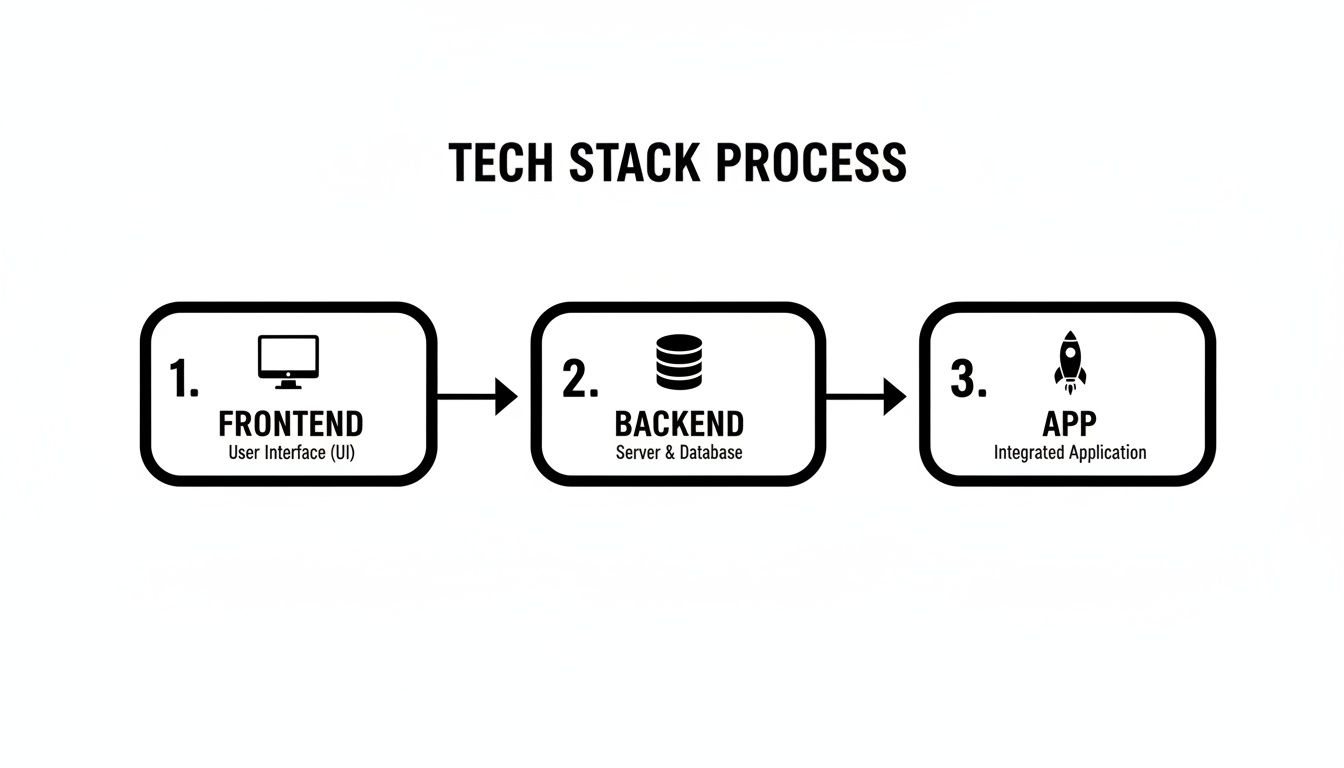 Diagram illustrating the sequential tech stack process: Frontend, Backend, and Integrated Application stages.
As you can see, each piece builds on the one before it, leading to a complete application that's ready for your users.
Agile Sprints and The Build Cycle
With the designs approved, it’s go-time for the developers. Most effective teams work in sprints—short, focused bursts of activity, usually lasting one or two weeks. At the beginning of each sprint, the team picks a small batch of features from the MVP list and commits to getting them done. This rhythm keeps the energy up and delivers constant, visible progress.
The unsung hero of this entire process is Git, a version control system. It's what allows multiple developers to work on the same project without overwriting each other's work. Think of it as a super-detailed change log for your code, letting you rewind to a previous version if something goes wrong.
Version control with Git isn't just a "nice-to-have." It's the safety net that protects your single most valuable asset: your code. It makes collaboration possible and prevents absolute disasters.
Testing and Automation Pipelines
As features get built, they need to be tested. Relentlessly. A classic startup mistake is to cut corners on quality assurance (QA) to go faster, but it always comes back to bite you. A buggy launch is a great way to lose users on day one.
To do this right, teams set up a staging environment. This is an identical copy of your live app, a private playground where new code can be tested in real-world conditions without any risk to your actual users.
Top-tier teams go even further with Continuous Integration and Continuous Deployment (CI/CD). These are automated workflows that build, test, and deploy new code as soon as it's ready. If a developer accidentally introduces a bug, the automated tests catch it immediately, preventing that bad code from ever reaching the public. It's the secret to moving fast without breaking things.
Conquering The App Store Submission
After all the building and testing, you’ve reached the final boss: the app stores. Getting your app onto the Apple App Store and Google Play Store is the last major step. Be warned, both platforms have long lists of strict rules covering everything from privacy and design to performance.
Getting rejected is a rite of passage for many developers. The key is to read their guidelines carefully and have all your materials ready—screenshots, an app description, a privacy policy, and more. The review process can take anywhere from a couple of days to over a week. But once you're through, you're officially live. By knowing what to expect at each stage, you can lead your team with confidence and set yourself up for a much smoother launch.
Launch Faster With A Strategic Development Accelerator
Imagine starting your app on day one by building the actual features that will win over users. No weeks spent wrestling with project setup, no endless debates over boilerplate code, and no time wasted solving problems that have been solved a thousand times over. This is the core idea behind a strategic development accelerator like AppLighter.
This approach completely changes the game for mobile app development for startups. Instead of staring at a blank screen, you kick things off with a powerful, pre-configured foundation. We're not talking about a basic template here; it's a complete, opinionated framework built for one thing: speed.
What an Accelerator Solves Immediately
A solid accelerator gets the most time-consuming and risk-prone parts of a new project out of the way from the get-go. It gives your team a battle-tested architecture so you can pour your limited resources into what actually makes your app special.
Here are the key pieces you get right out of the box:
- A Cross-Platform Foundation: Built on Expo and React Native, it lets you develop for iOS, Android, and the web all from a single codebase.
- Integrated Backend and Database: A secure database powered by Supabase and a high-performance API layer are already wired up and ready to go.
- Core Functionality Solved: Critical features like user authentication, screen navigation, and application state management are pre-built and good to go.
This immediately de-risks the whole project. You sidestep the common architectural mistakes that can grind development to a halt months down the road, and you dramatically slash the initial cost and time needed to get your MVP out the door.
A development accelerator turns weeks of foundational work into an instant advantage. It’s the difference between building a car engine from scratch and starting with a high-performance motor that’s already been tuned and tested.
The Before and After Comparison
To really see the impact, just think about the typical startup workflow versus one using an accelerator. Without one, your first few weeks are pure setup and configuration—tasks that deliver zero direct value to your future users. With an accelerator, that entire phase is crushed into a single day.
That head start is everything in a competitive market. The global demand for mobile apps has never been higher. With 7.3 billion smartphone users worldwide, a number projected to hit 7.9 billion by 2028, the potential audience is massive. These users are also incredibly active, spending over 4.2 trillion hours in apps in 2024 alone and driving revenues expected to top $935 billion. You can find more insights on the staggering growth in the mobile app market on Buildfire.
By skipping the undifferentiated heavy lifting of setup, you can focus your energy directly on building the features that will capture a slice of that market. You get to launch faster, gather feedback sooner, and iterate more quickly than competitors who are still stuck laying the groundwork.
Common Questions & Straight Answers
Even with the best-laid plans, building a mobile app always brings up questions. It's just part of the process. Here are some of the most common things founders ask, along with some no-nonsense answers based on our experience.
How Much Does It Really Cost to Build an MVP?
Let's get right to it: the cost to build a Minimum Viable Product can be all over the map, from a shoestring budget to well over $100,000. The final number really boils down to how complex your features are, how polished the design needs to be, and who you hire to build it.
Most simple, yet solid, MVPs land somewhere in the $10,000 to $25,000 range. If you're building something more ambitious with a lot of custom logic or integrations, you're probably looking at a $50,000 to $75,000 investment. One of the biggest ways to keep these initial costs down is by using a cross-platform framework like React Native combined with a starter-kit, which cuts out a ton of the repetitive, foundational work.
Freelancer vs. Agency vs. In-House: Who Should I Hire?
For a startup just getting off the ground, the real choice is usually between a freelancer or a small, focused agency. Your decision here has a massive impact on your budget and how you manage the project day-to-day.
- Freelancers: This is your most flexible and often most affordable path to an MVP. It's a great way to get moving without a huge upfront commitment.
- Agencies: They bring a full team to the table—project managers, designers, developers—which is fantastic if you need that extra layer of support and structure.
- In-house Team: This is the long-term play. Hiring full-time staff is a major financial commitment, and it's almost always smarter to wait until you've found product-market fit.
Here's a pro-tip: Starting with a development accelerator makes it easier to work with any of these options. It gives everyone a well-documented, stable foundation to build on, drastically cutting down on onboarding time and the risk of expensive mistakes.
So, How Long Will This Take? A Realistic Timeline
A typical timeline for getting a startup MVP from idea to app store is usually between 3 to 6 months. That window covers everything—initial discovery and design, the actual coding, all the testing, and finally, deploying it for the world to see.
But you can absolutely shorten that timeline. By using an accelerator or starter-kit that handles all the standard stuff upfront—things like user sign-up, screen navigation, and connecting to a backend—you can often cut 4 to 8 weeks right off your schedule. Getting to market that much faster means you can start the most important part of the journey: getting feedback from real users.
Ready to skip the setup and start building your actual features from day one? The AppLighter starter-kit gives you a production-ready foundation with everything you need to launch your Expo (React Native) app in record time. Grab your complete, pre-configured tech stack at https://www.applighter.com.
Related Articles
Mobile App Development Cost Calculator Guide
Use our mobile app development cost calculator to get a realistic budget estimate. Learn the key factors that drive app costs and how to save money.
Mobile App Tech Stack: How to Choose the Best mobile app tech stack
Explore how to choose a mobile app tech stack that fits your goals. This concise guide outlines layers, trade-offs, and how to accelerate MVP development.