How to Validate Startup Idea: A Practical Guide for Founders
Discover how to validate startup idea with a founder's playbook. Get practical steps for customer discovery, MVP testing, and lean experiments.
 Parth
Parth
So, you've got a killer idea for a startup. Before you pour your life savings and countless hours into building it, we need to talk about validation. What is it? In simple terms, it's about systematically checking your assumptions to see if you're building something people actually want and will pay for. It’s the process of collecting hard evidence, not just positive feedback from your friends and family.
This isn't just about getting a thumbs-up on your concept. It's about proving you've found a real, painful problem for a specific group of people who are actively looking for a solution.
Why Most Startups Fail and How Validation Can Save Yours
Let's get the harsh reality out of the way: most startups don't make it. And the number one reason isn't a lack of funding or a brilliant team—it's building a product nobody needs. I've seen it happen time and time again. A founder gets completely obsessed with their idea, goes into a cave for a year to build the "perfect" product, and launches to absolute silence.
 A workspace with a laptop, notebook, and crumpled paper, featuring a 'VALIDATE EARLY' sign.
This classic mistake comes from treating your core assumptions as proven facts. Every new business is just a collection of guesses: who the customer is, what they struggle with, and why your solution is the answer. The goal of validation isn't to stroke your ego; it’s to kill your bad ideas before they kill your startup.
The True Cost of Skipping This Step
I get it, especially if you're a developer. You want to build. Writing code and designing UIs feels like progress. But it’s often the most expensive and time-consuming way to learn. Every line of code you write for a feature nobody cares about is a sunk cost you can't get back.
"The purpose of validation is not to get a 'yes' or 'no' answer. It's to reduce the risk associated with launching something new by making small, informed decisions along the way."
Think of validation as insurance against your own blind spots and biases. It forces you to look at the cold, hard reality of the market before you're too deep in the trenches—financially and emotionally—to change course. Skipping this step is a gamble most startups lose.
It's All About Smart Resource Allocation
So, how do you learn fast without burning through your cash? The trick is to separate the act of building a product from the act of validating a business. You don't need a pixel-perfect app to test your riskiest assumptions. You just need to be clever.
This is where modern lean methods and tools really shine. For indie developers and founders building a mobile MVP, a starter kit like AppLighter is a game-changer. Instead of burning weeks on boilerplate stuff like setting up user authentication, screen navigation, or database boilerplate, you start with a solid foundation already in place.
This completely shifts where you spend your time and energy. You get to focus on what actually matters right now:
- Customer Discovery: Actually talking to potential users. Seriously, get out of the building.
- Rapid Experiments: Throwing together a quick landing page or a manual "concierge" service to see if people will bite.
- Learning and Iterating: Using real feedback to tweak your idea, make a pivot, or even shelve it before you've committed to a full-scale build.
Ultimately, learning to validate your startup idea is about a fundamental mindset shift. You stop being just a builder and become an investigator. Your primary job isn't to create a flawless product from day one. It's to find a problem that keeps people up at night and prove that your solution is the one they've been waiting for.
Crafting a Testable Hypothesis for Your Idea
Every great idea starts as a pile of educated guesses. You're guessing about who your customers are, what problems are giving them headaches, and why your solution is the one they’ll actually pull out their credit card for.
Before you write a single line of code, your first job is to get those assumptions out of your head and onto paper. This means framing them as a sharp, actionable hypothesis you can put to the test.
 A hand writing on a whiteboard with colorful sticky notes and the text 'TESTABLE HYPOTHESIS'.
Think of it less as an academic exercise and more as a strategic move. A solid hypothesis is your compass. It guides your validation efforts, keeps you focused, and prevents you from chasing vague notions that lead nowhere. It forces you to get crystal clear on what you believe to be true.
The Anatomy of a Powerful Hypothesis
A strong validation hypothesis isn't complicated. It really just has three core parts that snap together to tell a story. You're essentially creating a belief statement that you can then try to prove or disprove with real-world feedback.
Here's what it needs:
- A Specific Customer Segment: Who, exactly, are you building this for? "Everyone" isn't a customer segment; it's a recipe for failure. Instead of something broad like "business owners," drill down to "solo freelance graphic designers."
- An Acute Problem: What's the painful, urgent challenge this specific group is wrestling with? Vague problems get you vague answers. "Saving time" is a benefit, not a problem. "Spending 10 hours a week manually creating client reports" is a real problem.
- Your Proposed Solution: How will you make this specific problem go away for this specific group? This is where your unique value proposition comes in.
Putting these pieces together creates a clean, testable statement. For instance, a founder using a tool like AppLighter to jumpstart their mobile app could frame their hypothesis like this:
"I believe that indie developers building mobile apps struggle with slow, repetitive setup for authentication and state management. I think a pre-configured starter kit can solve this, saving them 40+ hours per project."
Identifying Your Riskiest Assumptions
Okay, so you have a hypothesis. Now it's time to play detective and find its weakest link. Every hypothesis is built on a stack of underlying assumptions, and some of them are far riskier than others. If your most critical assumption turns out to be wrong, the whole idea can fall apart.
Just ask yourself one question: "What must be absolutely true for this idea to work?"
Let's dissect the assumptions in our AppLighter example:
- Problem Assumption: Indie developers actually see the initial project setup as a significant pain point.
- Solution Assumption: They are willing to trust and use a third-party starter kit instead of building from scratch.
- Willingness-to-Pay Assumption: They are willing to pay money for this starter kit to make the pain go away.
So, which one is most likely to kill the business? It's almost always the willingness-to-pay assumption. People will complain about problems all day long. They might even say they love your solution. But getting them to actually open their wallets is the ultimate form of validation. This is where you should aim your first experiments.
The game has changed for startups. Success isn't about building the perfect product; it's about how quickly you can invalidate bad ideas. With first-time founders facing a tough 18% success rate, the biggest difference-maker is quality validation that gets you paying customers before you even launch an MVP. You can learn more by exploring this effective startup validation framework.
Making Your Hypothesis Measurable
A hypothesis is just a guess until you can measure it. The final, critical step is to attach a clear, quantifiable success metric. This turns your belief into something closer to a scientific experiment and takes the emotion out of your decision-making.
Here’s the difference:
- Bad Metric: "I'll know I'm on to something if people seem interested."
- Good Metric: "My hypothesis is validated if 15% of indie developers I drive to a landing page sign up for the early access waitlist."
This simple tweak gives you a finish line. When you hit that number, you've got a powerful signal to move forward. If you miss it, it’s a clear sign to pause, dig into the feedback, and tweak your hypothesis. This disciplined approach is the core of how you validate a startup idea without burning through your time and money.
Talking to Humans: The Art of the Discovery Interview
Alright, you've got a hypothesis that feels solid. Now for the hard part—the part most founders dread. It's time to get out of the building (or at least away from your IDE) and talk to real, live people.
This isn't a sales pitch. It's a fact-finding mission. The whole point of these customer discovery interviews is to listen, not to convince anyone your idea is brilliant. You're trying to get a raw, unfiltered look into the world of the people you want to help.
Your only goal is to understand their current reality. What are their workflows? What drives them crazy? What hacks have they jury-rigged to solve a problem? Forget compliments and future promises. You're digging for the truth about their past behavior, because that’s the only ground solid enough to build a business on.
Asking Questions That Don’t Get You Lies
Here’s the biggest rookie mistake I see: asking hypothetical questions. We humans are terrible at predicting what we'll do in the future. "Would you use an app that does X?" is a surefire way to get a polite "Sure!" that means absolutely nothing. It's feel-good feedback, but it's useless.
You need to become a historian, not a fortune teller. Dig into their recent, specific past. This is the whole idea behind frameworks like The Mom Test—learning to ask questions that are so grounded in reality, even your own mom can't give you a fluffy, supportive-but-unhelpful answer.
Let's see what this looks like in practice.
| Bad Question (Leading you to a dead end) | Good Question (Uncovering real behavior) |
|---|---|
| "Would you pay for an app that simplifies project setup?" | "Tell me about the last time you started a new mobile app project. What did that process look like?" |
| "Do you think having AI assistance would be useful?" | "Walk me through how you currently handle repetitive coding tasks. What tools or workarounds do you use?" |
| "If we built a tool to save you time, would you use it?" | "What were some of the biggest frustrations you faced during your last project build?" |
See the difference? The good questions don't even mention your idea. They are open-ended invitations for a story. And in those stories, you’ll find the real gold: the genuine pain points, the cobbled-together workarounds, and the true priority of the problem. Is it a minor headache or a "my hair is on fire" crisis?
Finding the Right People to Talk To
The thought of finding interviewees can be intimidating, but you just need to show up where your people already are. You’re not trying to poll a massive audience; you’re looking for 10-15 deep, meaningful conversations.
Here are a few places that have always worked for me:
- Niche Online Communities: Think specific subreddits (like r/reactnative), focused Slack groups, or industry forums. Don't just drop a link and run. Become part of the conversation, offer help, and then post something genuine. Try: "Hey everyone, I'm researching the challenges indie devs face with project setup. Would anyone be open to a 20-minute chat about their experience?"
- LinkedIn: Get specific. Search for the exact job titles you're targeting. Send a connection request that’s personal, not a sales pitch. Explain you’re doing research and you’d value their expert opinion on a problem in their field.
- Your Own Network: Never underestimate the power of a warm intro. Ask friends, former colleagues, or mentors if they know anyone who fits your customer profile. It's often the easiest way to get a "yes."
The most valuable currency here is honesty. When you ask for their time, frame it as a chance for them to help you learn. Most people are incredibly generous when they feel like they’re contributing their expertise, not being sold something.
From Conversations to a Clear Decision
After every single interview, take five minutes to write down your raw notes and highlight the big "aha!" moments. Once you have a handful of conversations under your belt, start looking for the patterns.
Are different people describing the same problem with the same words? Have they already tried (and failed) to solve it? Have they actually spent money on a clunky, imperfect solution?
These recurring themes are everything. This is your qualitative data, and it will either validate your hypothesis or wave a big red flag. If you consistently hear the exact problem you thought existed, you've got a strong "go" signal. But if you hear radio silence on your problem and a chorus of complaints about something else entirely? That's an invaluable "pivot" signal—a gift, really—telling you to change course before you waste a single line of code.
Running Lean Experiments to Test Your Solution
Okay, so you've done the hard work of customer interviews and confirmed you're sitting on a real, painful problem. It’s a huge milestone! The temptation to dive headfirst into coding is massive right now, but pump the brakes. You've only validated the problem. You haven't proven that your solution is the one people will actually pull out their wallets for.
This next phase is all about getting real-world data without writing a single line of production code. We're shifting from qualitative feedback ("Tell me about your struggles") to quantitative proof ("Will you give me your email or credit card for this?"). This is where you test your idea with actions, not just words.
The Power of a Smoke Test
One of the fastest ways to see if you have something is a Smoke Test. The idea is brilliantly simple: create the illusion of a product to see if anyone tries to buy it. The classic tool for this is a focused, no-nonsense landing page.
This isn't a full website. It’s a single page with one job: sell the dream. It needs to nail the problem, present your solution as the ultimate answer, and have a single, can't-miss call-to-action (CTA).
This whole process is the natural next step after your initial customer discovery.
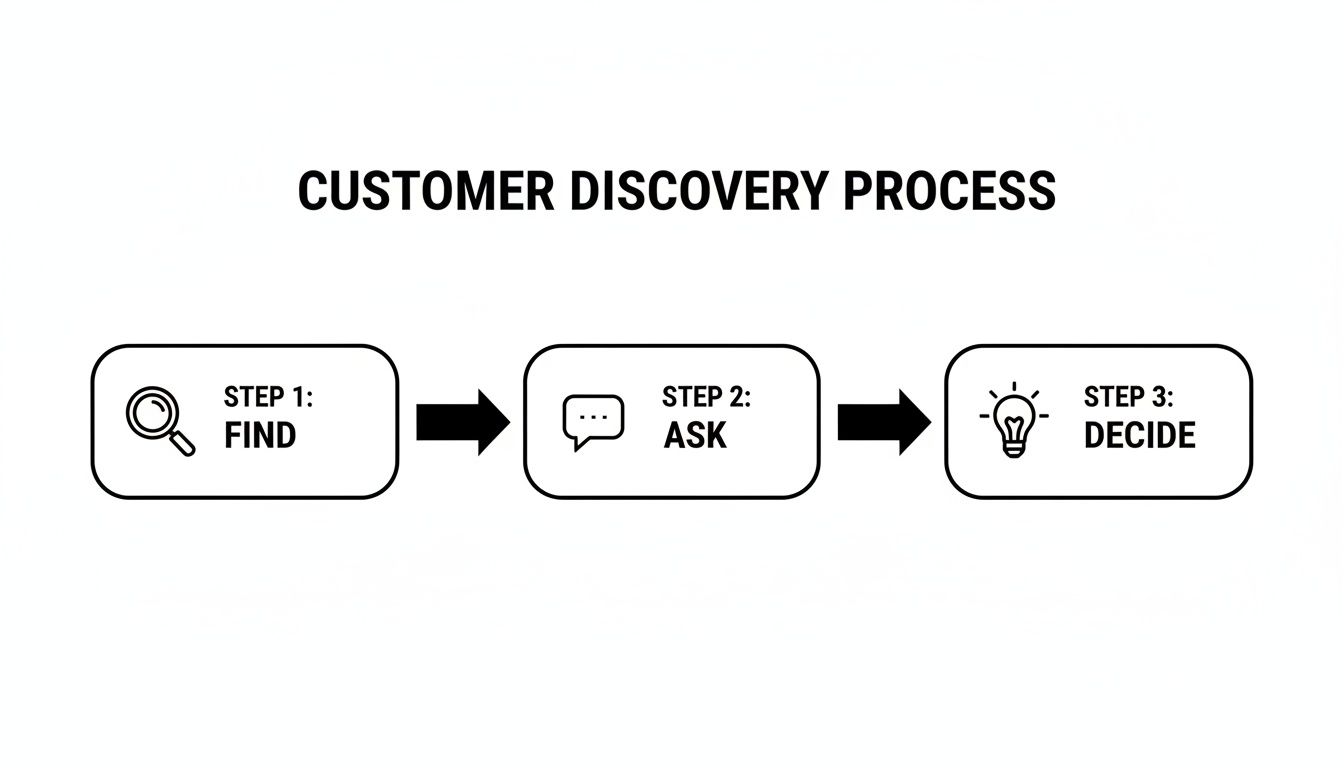 A simple diagram outlining the 3-step customer discovery process: Find, Ask, Decide, with icons.
This simple flow—finding the right people, asking the right questions, and then deciding what to test—is the bedrock of building something people genuinely want.
For a smoke test landing page, your CTA is everything. Here are a few solid options:
- "Join the Early Access Waitlist": This is your go-to for measuring interest. An email address is a low-commitment currency, but it starts building an audience of hand-raisers.
- "Pre-Order Now for a 50% Discount": The holy grail of validation. Asking for money is the ultimate acid test. If people pay for a solution that doesn't exist yet, you've hit a nerve.
- "Request a Demo": Perfect for B2B ideas. This CTA tests whether potential customers are willing to trade their valuable time to see what you've got.
Don't overthink the tech. Tools like Carrd or Webflow let you spin up a professional-looking page in an afternoon. To get traffic, you don’t need a huge marketing budget. A tiny, targeted ad spend on LinkedIn or Reddit—even just $100—can send enough of the right people your way to get a clear signal.
The Concierge MVP: A Hands-On Approach
While a smoke test gauges raw interest, a Concierge MVP validates your solution's process by delivering it completely manually. Forget the code for a minute. You are the software. You find a few pioneering customers and personally deliver the outcome, doing all the work by hand.
Let’s say you're building an app to automate social media content for small businesses. A Concierge MVP would look like this:
- Find three local shops who agree to be your guinea pigs.
- Jump on a call to understand their brand, goals, and what they need.
- Then, you personally write their posts, design the graphics (hello, Canva!), and schedule everything using their existing accounts.
- You collect feedback constantly, tweaking your "service" on the fly.
The value here is immense. You're not just testing demand; you're living the workflow. You'll uncover every frustrating step, every edge case, and every "aha!" moment your future software needs to handle. This firsthand experience is priceless and will directly inform the features you actually need to build.
"The Concierge MVP is all about doing things that don't scale. You're trading automation for learning, getting an unparalleled look into your customer's world before you've invested heavily in engineering."
This manual approach ensures your product is based on a proven, real-world workflow, not just something you dreamed up. For founders using a starter kit like AppLighter, these insights are gold. They help you pour your development energy into the unique features that deliver the core value, since the boilerplate stuff is already handled.
Lean Validation Experiment Comparison
Choosing the right experiment is key to getting the signal you need without wasting time or money. This table breaks down the most common methods to help you decide where to start.
| Experiment Type | Primary Goal | Cost | Time to Launch | Best For |
|---|---|---|---|---|
| Landing Page / Smoke Test | Gauge initial market demand and validate the value proposition. | Low ($50 - $200 for ads) | 1 - 3 days | Testing broad consumer or B2B ideas with a clear, single value prop. |
| Concierge MVP | Deeply understand the user's workflow and co-create the solution. | Very Low (Your time) | 1 - 2 weeks | Service-based ideas or complex B2B workflows where the process is key. |
| "Wizard of Oz" MVP | Test a seemingly automated product that is actually human-powered. | Low to Medium | 1 - 3 weeks | Ideas that rely on complex automation (e.g., AI, matching algorithms). |
| Video MVP | Explain a complex product or service in a simple, engaging way. | Low ($0 - $300) | 3 - 7 days | Demonstrating a physical product or a complex software concept. |
Ultimately, the best experiment is the one that gives you the most learning for the least effort. Don't be afraid to combine them or create your own hybrid version.
Choosing Your First Experiment
So, which path do you take? It really depends on your idea and what you need to learn next. A smoke test is fantastic for getting a quick read on broad market interest. A Concierge MVP is unbeatable for deeply understanding the nitty-gritty of a service-based solution.
Both are powerful ways to make data-driven decisions. They ensure you’re on the right track before you commit your most precious resources: your time and money.
How to Know if You're Actually on to Something
It's easy to get excited about page views and social media likes. They feel good, right? But here's the hard truth I've learned over the years: they won't tell you if you have a real business on your hands. Chasing these vanity metrics is a classic trap. It makes you feel productive while you're actually just flying blind.
To really know if your idea has legs, you have to cut through that noise. The question isn't "Do people like this?" It's "Are people willing to do something about it?" That "something" could be trusting you with their email address, giving you 30 minutes for a demo, or—the holy grail of validation—giving you their money. These are the actions that prove you're solving a real problem.
Defining Your Key Validation Metrics
Before you launch a single experiment, you have to decide what winning looks like. If you don't define the finish line upfront, you'll inevitably twist the data to fit the story you want to hear. Trust me, we've all been there. For this early stage, keep your Key Performance Indicators (KPIs) dead simple and tied directly to a user's action.
Here are the only metrics you should be obsessing over right now:
- Landing Page Conversion Rate: This is your bread and butter. It's the percentage of visitors who actually take the action you want them to, like joining your waitlist or hitting that "pre-order" button. It's the purest measure of how well your pitch is landing.
- Willingness-to-Pay Signals: Money talks. Pre-orders, paid pilot programs, or even just collecting credit card info for a future charge are the strongest signals you can possibly get. It's proof that you've found a real pain point.
- Qualitative Feedback Score: After a demo or a hands-on concierge MVP session, ask this simple question: "On a scale of 1-10, how disappointed would you be if this solution no longer existed?" This is a stripped-down version of the famous Sean Ellis test, and it gets right to the heart of product-market fit.
Setting this up is easier than you think. You can configure Google Analytics in a few minutes to track button clicks as conversion events. For the qualitative score, a simple survey form works perfectly.
Your goal isn't to drown in data. It's to find the right data—the handful of numbers that give you a clear, undeniable signal to either build, pivot, or walk away.
Setting Benchmarks for a Clear Go or No-Go
Okay, so what does a "good" number even look like? This is where a lot of founders get stuck. A 5% conversion rate might feel disappointing, but depending on your industry and where your traffic is coming from, it could be a massive win. You need benchmarks to make an informed call.
Conversion rates are everything at this stage. While they can vary wildly, a solid rule of thumb is that a conversion rate on your main call-to-action from cold traffic that hits over 15% is a very strong signal. In many niches, you might even be looking for a rate that pushes past 20%. The mission for your first 30-90 days is simple: find at least 10 paid users who would be genuinely upset if you took your product away. Dive deeper into these critical startup validation metrics to get a better handle on setting targets for your own idea.
Here's a straightforward framework to get you started:
| Metric | Weak Signal (Time to Re-think) | Strong Signal (Green Light to Build) |
|---|---|---|
| Email Signup Conversion | Below 5% | Above 15% |
| Paid Pre-Orders | 0-2 from 1,000 visitors | 10+ from 1,000 visitors |
| "Disappointment" Score | Average score below 7 | Average score of 8.5+ |
These aren't laws set in stone, but they're a damn good place to start. If you land in the "weak signal" column, don't sweat it. That's not a failure; it's a huge success! You just saved yourself months of building something nobody wants. Now you can use the feedback you gathered to tweak your messaging, adjust your audience targeting, or rethink the core idea and run the next experiment. This is the game—a cycle of testing and learning that de-risks your idea one step at a time.
Common Questions About Validating a Startup Idea
Even with a solid playbook, the validation journey can feel a bit like walking a tightrope. It's totally normal for questions to pop up as you try to turn a fuzzy concept into something backed by real evidence. I've been there. This section is all about tackling those common hurdles and tricky "what-if" scenarios that trip up founders.
Think of this as a quick-reference guide for when you get stuck. I'll give you some straight-shooting answers to the questions I hear most often, helping you cut through the noise and move forward with confidence.
How Much Validation Is "Enough" Before I Start Building?
This is the big one, isn't it? Everyone wants a magic number, but the truth is, there isn't one. What you're really looking for is a pattern of repeatable, compelling evidence that you've struck a nerve. The goal here is simple: kill the biggest risk—that nobody cares—before you sink a ton of time and money into coding.
A strong signal is usually a mix of what people say (qualitative) and what they do (quantitative). I generally tell founders they have a strong green light when they've hit a few key milestones:
- You've confirmed the problem. After 10-15 deep customer discovery interviews, you're hearing the exact same painful problem over and over, without you leading them to it. They should be bringing it up themselves.
- Your solution gets a nod. You've run a quantitative test, like a landing page smoke test, and hit a conversion rate of at least 10-15% from a highly relevant audience. This is a good sign that your value prop is actually resonating.
- You've seen the money. This is the acid test. You've managed to secure 5-10 pre-orders or some other form of financial commitment before the product even exists. When someone pulls out their wallet, that’s the ultimate validation.
Once you’ve checked these boxes, you’ve got a powerful, data-backed reason to start building your MVP.
What Do I Do When My Experiments Show My Idea Is Bad?
First off, take a deep breath and give yourself a high-five. Seriously. Discovering your idea is a dud is a huge win. The entire point of this process is to find that out as cheaply and quickly as humanly possible, saving you from a world of pain down the road.
An invalidated hypothesis isn't a failure; it’s a course correction. It’s a gift that points you toward something that might actually work.
Don’t get married to your first idea. The best entrepreneurs aren't obsessed with a single solution; they're obsessed with solving a real problem. Invalidating an idea is just part of the hunt for the right one.
When an experiment flops, you have to become a detective. Dig into the "why."
- Were you talking to the wrong people?
- Is the problem just a minor annoyance, not the hair-on-fire issue you thought?
- Was your proposed solution just not compelling enough to make them act?
Use these insights to pivot. Tweak your hypothesis and run a new, smarter experiment. Or, if the evidence is overwhelming, have the courage to put the idea on the shelf and move on. This brutal, rapid cycle of invalidation is what separates the founders who eventually succeed from those stuck building something for an audience of one.
Can I Really Validate an Idea with a Zero-Dollar Budget?
Absolutely. While a small ad budget can definitely speed things up, you can get incredibly far without spending a dime. In these early days, your time and hustle are far more valuable than your cash.
For customer discovery, tap into your personal and professional networks. A warm intro is worth its weight in gold. Beyond that, go where your potential customers already hang out online.
- Niche Subreddits (think r/saas or r/indiehackers)
- Industry-specific Facebook Groups and Slack communities
- Professional hubs like LinkedIn
For a smoke test, you can use a free landing page builder like Carrd and drive your first wave of traffic by sharing your link in those same online communities. A "Concierge MVP" is another zero-cost powerhouse, where you manually deliver the service using nothing but your own effort. At this stage, resourcefulness is your superpower.
Ready to turn your validated mobile app idea into reality without wasting months on boilerplate code? AppLighter gives you a production-ready foundation with authentication, navigation, and a pre-configured backend, so you can focus on building the features that matter. Check out AppLighter and start building faster today!
Related Articles
Build Business Automation Software Into Your App
A practical guide on how to build business automation software features into your app using modern tools. Learn to design, build, and deploy custom workflows.
How to Monetize Apps A React Native Developer's Guide
Learn how to monetize apps using React Native and Expo. Our guide covers proven revenue models, in-app purchases, and backend setup for iOS and Android.
Mobile App Development for Startups Your Ultimate Guide
Master mobile app development for startups with our step-by-step guide. Learn to validate your idea, choose a tech stack, and launch your MVP fast.